Segment VI – A Subdued Silence (Chapter 23 – The Soldiers’ Brigade and Echoes Of Battles)
For the entirety of the Series, please see – https://chroniclesinzealotry.com/fugitives-of-the-peninsula/
This Segment concluding Chapter engages with the AQAP effort to develop into a broader entity, one which could encapsulate the vestiges of the previous Saudi iteration, but also one that was obligated to rely on local, tribal, and personal Yemeni contacts. Additionally, we attempt again to distinguish between Yemeni incarceration and actual justice for terroristic crimes, while examining the new network’s expanding propaganda influence. Again, with this amount of support from the Yemeni government, it would be unwise to open an overt front against them, forcing AQAP to follow the path of AQSA in delineating the offensive against Yemeni forces to a front organization. We conclude with the first major US Embassy attack of the aughts.
Saudis and Locals
Nasir al-Wuhaishi and his rejuvenating al-Qaida franchise was of course dependent upon local Yemeni operatives, but needed foreign elements for continued growth. As such, the cell eliminated by the Yemeni government in response to the Queen of Sheba terror attack and US encouragement, was also revealed to be providing shelter to the de facto leader of the remaining Saudi militants, Naif Mohamed al-Qahtani [1,2].
To that point, while some see Qahtani as leading the “Saudi branch” of the network at this time, he may have just been handling finances for Wuhaishi’s cell, as his relative youth at the time would seem to exclude him from a favored leadership position [2,3,4]. That being said, with essentially all of the in-Kingdom wanted Saudis dead or captured, a fighter with little experience may have been the only person to step up and take command of the remnants. This would also explain Qahtani’s willingness to attach with and merge with Wuhaishi’s group. As such, Qahtani was actively involved with online endeavors to recruit more Saudis to Wuhaishi’s cause in Yemen [2]. The organization needed more fighters to replace the likes of their early losses.
Following the Yemeni security raid resulting in the deaths of AQAP adherents Ali Doha, Naji Jardan, Abdulaziz Jardan, and suicide operative in training Amir Harradan, gunmen attacked the city of Marib, hitting police checkpoints, a government center, and a power station [5]. While the power station sustained damage, there were no casualties in the events [5]. The gunman may not have been AQAP fighters, but rather family members or tribal members of the slain operatives [6]. The response by the tribes, if true, shows the delicacy of conducting anti-terror raids in feudal zones like Marib. Such responses highlighted the Yemeni government’s hesitancy to take full measures against the militants. However, with American pressure on the Yemenis, it appeared to AQAP that the security forces were willing to take the chance in order to quell the potential uprising and insurgency at hand. It may also have been just in response to the assassination of Col. Qasaylah.
The COLE Conspirators
With such thoughts in mind, Jamal al-Badawi (G-1), decided to remove himself from the hunt and cut a deal with the Yemeni government in hopes of keeping out of the line of fire. Badawi had been a fugitive since the mass escape in 2006, although his involvement with AQAP affairs during that time is relatively unknown. He must have been involved with them to a degree as he is purported to have been hiding with them due to the fact that his eventual surrender was conducted via negotiations between the Yemeni government and AQAP itself [7]. Badawi’s potential lack of involvement with new operations may be underscored by the fact that he was initially very wary of the consequences of the prison break [8]. On October 16, 2007 it was widely reported that Badawi had turned himself into authorities [7]. Badawi appears to have surrendered and disavowed violence and militancy in exchange for a lesser sentence, house arrest, or freedom in general [7,9]. As part of the security guarantee, Badawi vowed allegiance directly to President Saleh. Almost immediately after his arrest, Badawi was seen by his neighbors and other witnesses returning to his home [7,9]. Badawi was yet another Yemeni jihadist to take advantage of the government’s security guarantees. With Badawi’s “vow” never to conduct or plan terrorist activities within Yemen he was allowed to leave confinement and stay under house arrest [10]. The security guarantees offered to the militants apparently erased any previous sentences. Of note, Badawi’s security guarantee came about despite the fact that he had earlier received a death sentence (later commuted to 15 years) stemming from his first escape [10]. It seemed as if this sentence did not matter to the Yemenis when they released him. As was expected, the American government was enraged that Badawi was released and demanded access to the terrorist, who at this point had a $5 million US bounty on his head [10]. US pressure forced the Yemenis to place the fugitive back in a State Security prison a few days after his release on guarantee [10]. This time Badawi was forced to remain in prison although President Saleh and the Yemeni government inexplicably promised him a pardon [10]. It has also been asserted that Badawi was only imprisoned when the Americans were inquiring about the fugitive’s whereabouts after his “surrender” [11]. Despite this, by September of 2010, Badawi engaged in a hunger strike at a state security prison due to the fact that he had not yet been released by Eid al-Fitr of that year, as was purportedly promised by President Saleh [10]. He survived this episode and remained on the FBI’s most wanted list [12].
Along these same lines, it is necessary to examine Jamal Badawi’s fellow operative in the COLE Bombing, Fahd al-Quso. Quso, as has been mentioned, joined Badawi in the 2003 prison escape and remained free for over a year [13,14]. He was in 2004, convicted for his role in the bombing and given 10 years with time served to be subtracted [14,15]. As Quso did not escape from prison in 2006, US officials felt assured that the Al-Qaida fighter would remain incarcerated for the duration of his sentence. According to a March 2008 cable from the US Embassy in Yemen however, disturbing news had been obtained as to Quso’s actual whereabouts [15]. While the Embassy and intelligence officials were following up on Jabir al-Bannah, they discovered evidence in a news article that Quso might no longer be imprisoned [15]. The Americans approached the PSO (Political Security Organization – who incidentally were in charge of the prisoners in the mass escape) and inquired of Quso. The cable, which also revealed Badawi to still be imprisoned, stated that the PSO reluctantly admitted that Quso had qualified for parole and had been released in May of 2007 [15]. More disturbing than Quso’s release was that the Yemeni government had withheld this information from the US Embassy, tried to cover it up in the press reports, and had been monitoring/protecting Quso for nearly a year at that point [15]. Quso upon release reintegrated himself into militant society and due to his fame found it an easy journey into AQAP’s waiting embrace [16]. In the end, Quso served not even 6 of his 10 sentenced years in prison [15].
Echoes of Battles
The beginning of 2008 saw AQAP begin what would become a long tradition of press releases and “magazines.” January 2008 saw the first of these entitled “Echoes of Battles” which demanded the release of jailed jihadists [17]. The Sada al-Malahim online magazine (Echoes of Battles) was a significant achievement for Wuhaishi and his men as it gave them an outlet for their ideology and a viable recruitment tool. As such, the first issue contained a detailed interview with Naif al-Qahtani (Abu Hammam al-Qahtani) as to his reasoning for joining the Jihad in the Arabian Peninsula as opposed to Iraq [17]. The young Qahtani was in fact the creator, editor, and impetus behind Sada al-Malahim, and the pioneer of what would eventually become a media machine for AQAP [18]. The year also began with Wuhaishi yet again committing violence against Westerners within the country, just a few days after the initial Sada al-Malahim release. On January 18, four gunmen in a pickup truck ambushed a four car convoy of tourists near the ancient mud dwelling of Shibam in Hadhramout province [19,20]. The gunfire left two Yemeni drivers and two Belgian tourists dead in the relatively safe region [19,20]. AQAP continued to shatter any sense of peace within the nation.
On February 24 of that year, yet another series of press releases was commenced by the extremists. In this first announcement, a group calling itself the Yemeni Soldiers’ Brigades (or Soldiers’ Brigades of Yemen), released an online statement claiming credit for the Qasaylah assassination, as well as the attacks on both the Spanish and Belgian tourists [21]. This particular group was led by Hamza Salim Amir al-Quayti (G-8) and would eventually be involved in actively targeting Yemeni security forces [21]. Many analysts were quick to assert that Quayti and his men had broken away from Wuhaishi and the two were operating as unique and separate entities with differing goals [21]. This proved not to be true, as Quayti and his men were revealed to remain under Wuhaishi’s leadership though they had the autonomy to act independently from the rest of the movement [21,22]. Quayti appeared to be gearing his men towards more of a guerilla war, instead of an organization conducting highly planned operations with less frequency, while Wuhaishi seemingly had his central followers focusing on attacking foreign interests. This situation can be seen as an analogue to the relationship between AQSA and the al-Haramain Brigades, a not-so-separate phantom unit which attacked Saudi security forces while allowing its parent organization to distance itself from such actions as it perpetrated violence against foreign interests [23]. Quayti’s tactics involved multiple strikes against Yemeni targets, although they were still able to claim responsibility for the other grandiose and attention garnering attacks due to their inclusion within Wuhaishi’s ranks [21,22].
On March 13th, the second issue of Sada al-Malahim was released by Wuhaishi’s men and within it they ceased calling themselves Al-Qaida in Yemen and commenced usage of a variant of the term we are familiar with today: Al-Qaida in the Arabian Peninsula [21]. It is a variant in the issue because the group actually called itself Al-Qaida Organization of Jihad in the Southern Arabian Peninsula, which eventually evolved back into AQAP [21,24]. The second issue of Sada al-Malahim was better coordinated and began to show a lot of Saudi influence within, as those surviving militants came to join the group [25,26]. Within the issue, Naif al-Qahtani called for the unification of Saudi and Yemeni jihadists [27]. As with the first issue of the magazine, the second one was followed by a brazen attack. This time the US Embassy in Yemen was targeted with mortars [28,29]. The three rounds fired fell short of the Embassy and crashed into a Yemeni girls’ school, killing one guard there and wounding several of the high school aged girls [28,29]. The Yemeni government attempted to minimalize damage to their image and claimed that the girls’ school was the actual target, but this was disputed by a man asserted to be escapee Zakariya al-Yafai, who confirmed that the Embassy had indeed been goal [27]. In addition, the YSB quickly claimed credit for the failed Embassy strike [25]. The claim was interesting as it provided a glimpse at the AQAP ideology and how they justified civilian collateral damage. For instance, the statement read that the group regretted that the teenage girls were hurt and the guard killed but that “previously, we have warned Muslims about not getting too close to government and foreign offices [25].” This was a frightening statement, not just for foreigners within the country, but for the Yemeni public itself. The YSB, on March 29, released a video further proving and cementing its ties to Wuhaishi’s network [22]. The video showcased a man calling himself Abu al-Miqdad al-Sanaani who proclaimed that he worked for the YSB and was a suicide bomber [22]. The video was the last recording of Abdah Mohamed Ruhaiqa, the Queen of the Sheba suicide bomber, and was released on the anniversary of the Qusaylah assassination [22]. The recording also contained a motive for the July 2007 attack: revenge for the killing of Fawaz al-Rubayi [22]. These facts further displayed that Quayti’s and Wuhaishi’s groups were indeed not only interlinked, but the same.
Quayti’s brigade continued to claim credit for attacks within the nation, including the late March attacks on a French pipeline and Chinese oil field as well as multiple checkpoint clashes with security personnel [25]. Meanwhile, Yemen named Hamza al-Dhayani as a chief suspect in the mortar attack while claiming to be searching vigilantly for the perpetrators [30]. This assessment was called into question when many witnesses reported seeing Qasim al-Rimi mingling with people at a funeral in the middle of a March day in Sanaa [27].
On April 6, mortars were fired at a residential compound in Hadhramout that housed Westerners but the attack caused no casualties [27]. After their mortar attack, the Yemeni Soldiers’ Brigade continued its 2008 campaign of attacks by focusing primarily on the Yemeni security forces, conducting a series of minor attacks, ambushes and bombings against targets within that category [27]. However, they still conducted strikes on foreign targets as well, including pipeline incidents and attacks such as an April 30 launch on the Italian Embassy in which two mortars were fired, but no casualties reported [27].
The release of the third issue of Sada al-Malahim came in May and warned a variety of foreigners in Yemen, including journalists, tourists, and professors that the militants have a religious duty to target them for death [27]. The fourth issue, released in July, went as far as to express disappointment in those escapees who had entered into agreements with the Yemeni government for their freedom [27]. However, as mentioned several of those militants benefiting from the security guarantees still maintained contact with jihadist groups and acted on their behalf.
Also, on April 3, 2008, amongst growing pressure from the US and other countries for Yemen to answer the call on bringing these militants to justice, the Yemenis announced they had rearrested Abdullah al-Rimi during a police operation [31]. The media ran with the story and the West was seemingly pleased [31]. The problem with the announcement was that the Yemenis had arrested an Abdullah al-Rimi but not the Abdullah al-Rimi [31]. In fact, despite clear evidence that the man was not the actual fugitive Rimi, and despite his family’s pleas, he was held by the PSO until December of 2009 as a political prisoner before being released [31]. Perhaps most disturbing from this episode is the conclusion that the real Abdullah al-Rimi had to have been released from PSO custody at some point after his 2006 capture.
The Soldiers’ Brigade Finality
While the Yemenis continued to structure their façade of compliance in bringing the militants to justice, AQAP and the YSB furthered their insurgency. On July 23, 2008 Quayti released a video in which he demanded that the Yemenis release militant prisoners or else face retribution [21]. Two days following, a Kia vehicle was driven through the gates of the Central Security compound in Sayoun, Hadramout province and detonated [27,32,33]. The bombing killed at least four Yemeni security forces as well as the suicide bomber [32,33]. The operative, Ahmed Said Omar al-Mashjari (Abu Dujanah al-Hadhrami) was a medical student from Sana’a and was trained by Naif al-Qahtani from the Wuhaishi cell [27,32,33]. Both Wuhaishi’s group and the autonomous YSB under Quayti claimed credit for the attack further exemplifying their connections and continual working relationship [27,33]. The militants listed several of their dead brethren who were killed by Yemeni security forces as to explain a motive for the attack [33]. Among those named was Yahya Mujali, the elder brother of escapees Hizam and Arif [33].
Quayti made a statement three days later directly to Ghalib al-Qamish, the head of the PSO [27]. Both Quayti and AQAP stated that the bombing and other attacks on Yemeni security forces were in retaliation for the deaths of AQAP members. The Yemenis were now under significant pressure from their own forces, their own public, as well as foreign governments to do something about the swelling insurgency. The Yemenis moved quickly to obtain a victory against the group and exploit the surrounding media coverage for the resulting positive press. Apparently, the specific insults against Qamish and the strikes on security forces turned the Yemeni government’s ire upon the YSB, though not against AQAP as a whole. The Yemenis seemed intent on propagating the assertion that Quayti’s group and Wuhaishi’s were different, citing sources that said Quayti continued attacks in order to keep his men in a fervor while Wuhaishi took more of a calculated approach, attacking only when he could obtain desired results [27].
On the night of August 10, Yemeni intelligence gathering efforts helped track an Al-Qaida cell to a compound in Tarim, Hadramout province [21,34]. Security forces cordoned off the area and began an intense incursion which led to a firefight with the extremists inside [21]. Intelligence gathered after the brigade had published a photo and biography of Mashjari steered authorities to the cell and resulted in the bloody gunbattle which ensued [34]. An initial patrol came under fire and called for heavy reenforcements against the militants [21]. After the cordon was established, the gun battle resumed in the morning with the militants firing RPGs and machine guns while the Yemeni forces brought in tanks and heavy weaponry [21]. The militants sortied out of their compound, but five were killed and two captured as they could not eventually evade the encircling forces [21,34,35,36,37]. The battle also left two Yemeni police officers dead in its aftermath [36,37]. Yet despite this, the raid was a success as authorities were able to find a significant depot of weapons and explosives within the compound, including 40 bags of gunpowder and TNT [34,35]. They also discovered documents and supplies which indicated that the group was planning attacks on Saudi targets and oil installations [35,36,37]. The greatest success was that the overall operation focused on Hamza al-Quayti (G-8).
Quayti was known prior to his fame stemming from the Sana’a prison escape and his guerilla war in 2008 against the Yemeni authorities. Quayti had been a prominent fighter in Afghanistan [38-43]. As such a significant figure (he is often identified in leaked government documents as Abu Hamza al-Quayti) he oversaw a guesthouse for Al-Qaida in Kabul [38]. He is also purported to have provided training for militants at a camp [39]. The guesthouse provided shelter for militants arriving in the country, preparing for training and resting from the frontline battles against the Northern Alliance [38-46]. Several Guantanamo detainees reference Quayti as an al-Qaida facilitator in leaked assessment files (including ISN 242, ISN 553, ISN 179, ISN 308, ISN 549, ISN 255, etc) [38-43]. In addition, the leaked files state that the intelligence analysts and the Yemeni PSO could confidently place Quayti in Afghanistan up through December of 2001 [45]. Afterwards, the militant fled Afghanistan during the fighting, probably from Tora Bora and was eventually extradited back to Yemen from Saudi Arabia [44,46]. He had first set up yet another guesthouse, this time in Iran, for fleeing militants [46]. He was extradited on September 24, 2003 along with the Baihani brothers Zakaria and Mansur in exchange for Bandar al-Ghamdi (A-12) [44]. The long time Al-Qaida facilitator and YSB leader did not escape the battle in Tarim [34,35,36,37].
The dead YSB militants in Tarim were named as Abdullah Ali Batis, Hassan Bazara, Mubarak Hawil al-Nahdi, Mahmud Baramah and Hamza Salim al-Quayti (G-8) [21]. The death of Quayti was immediately hailed in the press as a crushing blow for AQAP and everyone in the Yemeni government up to President Saleh himself were quick to claim credit for the engagment and to exclaim its significance [34,37]. Although it was important to remove Quayti from the battlefield and put an end to his exploits as head over the YSB, his death was not a fatal blow to AQAP, as the rest of their leadership remained intact. Quayti’s Tarim cell was primarily localized as he, the four other dead and two captured militants (Ali Muhsin Saleh al-Akbari and Mohamed Said Bawaydhan) were all from the area surrounding Tarim [21]. However, passports for the Sayoun suicide bomber Mashjari, and two Saudis named Badah Mukhlis Badah al-Qahtani and Walid Radi al-Sumailil al-Otaibi, were retrieved from the scene [35]. This further demonstrated the developing relationship between the Saudi and Yemeni militants as AQAP evolved. The Yemenis hunted several YSB suspects in the immediacy after the battle and captured several, apparently due to information gleaned from Akbari and Bawaydhan [47]. Eventually, sixteen members of the YSB subset of AQAP were convicted on July 13, 2009 [48]. Bawaydhan and nine others (including another Saudi named Abdullah Ali Saleh Bawazir) were sentenced anywhere from eight to fifteen years imprisonment while Akbari and five others were sentenced to death for their roles in the YSB campaign [48]. One of those sentenced to death was Khalid Muslim Batis, who along with the others convicted, would factor into the future of militancy in Yemen yet again [48]. With the battle in Tarim, Yemen had successfully decimated a localized cell and killed one of its most wanted militants, but it had not incapacitated the insurgency. The Yemenis felt they had pleased the US and Western governments however, and seemed satisfied with this one achievement [21]. They quickly realized the folly of such complacency.
A Tormented Embassy
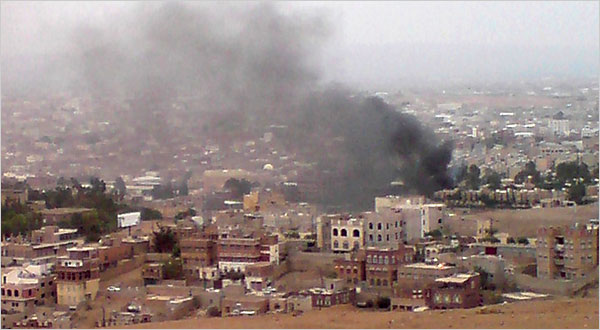
On September 17, 2008 the US Embassy in Sana’a, Yemen came under attack in the biggest act of aggression towards a US Embassy since the 1998 East African Embassy bombings [49,50,51,52]. The first vehicle full of armed extremists arrived at the Embassy gates at 9:15 am as Yemenis lined up outside in their attempts to obtain visas [49,50,51,52]. To its credit, the Embassy itself was very well secured and fortified. As the attackers poured forth, they unleashed a heavy volley of gunfire and RPG rounds at the Embassy guards, commencing a battle nearly half an hour long [51]. The first vehicle and the assailants within (all dressed in security force uniforms), seemed to be a distraction for a second vehicle, acting as a car bomb to attempt to breach the walls [49,50,51,52]. The explosion was massive but failed to penetrate the compound [52]. The State Department reported that both vehicles involved in the attack eventually detonated [51]. From outside, the Embassy also came under fire from snipers during the battle [53]. According to US diplomats, none of the Embassy staffers were killed in the brazen attack [50]. However, six of the Embassy guards, all Yemeni, and seven civilians were killed in the cluster of explosions and gunfire [49,50,51,52,54]. In addition to these deaths, seven AQAP attackers were left dead as well, including one wearing a suicide vest [49,55]. Initial reports only indicated that six attackers were involved, most likely due to the damage done to the seventh militant’s body in his suicide bombing [49,50,51,52]. The squad that conducted the raid was composed of a local cell dedicated to Wuhaishi’s vision [55]. They were led by an ideologue known as Lutfi Bahar, who after months of training, chose to join his six students on their martyrdom mission [56]. At least three of the militants did not need intense amounts of training as they had already gained experience from fighting in Iraq [54]. Bahar was lauded for this mission by AQAP leaders such as Qasim al-Rimi [56]. In a press statement, a group calling itself Islamic Jihad in Yemen claimed responsibility for the Embassy strike but this later proved to be yet another front for Wuhaishi and AQAP [49,50,51]. The AQAP admission of responsibility described the squad as the Abu Ali al-Harithi Brigade and named the attackers as Lutfi Mohamed Bahar (who not only mentored the cell but was the initial militant to sacrifice himself in the strike), Mahmud Saad al-Zakiri, Qabus Said Masud al-Sharabai, Yahya al-Fatini, Rashid al-Wasabi, Zayn Tuhmas and Walid al-Gharam al-Rimi [57]. Furthermore, a year later the last wills of the attackers were released in video format [58]. Walid al-Gharam al-Rimi and Lutfi Bahar promised specifically that AQAP would attack Americans not just in Yemen, but in other countries, and even in the US itself [58]. Among the dead civilians in the Embassy attack were six Yemenis and one American [52,55]. Susan al-Bannah was an 18 year old Yemeni-American from Lackawanna, New York [52]. It is the same New York town where Kamal Derwish had recruited the Lackawanna six and their cohort Jabir al-Bannah [52]. In a startling coincidence, Susan and Jabir were cousins [52]. Susan recently had her marriage arranged to a Yemeni national and was in Sana’a at the Embassy in order to get her groom a visa for entrance into the US [52]. The family stated that Susan and Jabir did not know one another [52]. The story of Susan al-Bannah is a microcosm for the story of Al-Qaida overall. The militants intend on battling, striking, and destroying Western and American interests, but more often than not they only kill their own fellow Muslims, countrymen, and family. The people they claim to be fighting for are usually the victims of their atrocities. Susan al-Bannah remains as one of the most poignant examples of this fact, another unnecessary casualty in this interminable war. This troubling and difficult conflict was rejuvenated with Wuhaishi and his fellows escaping prison, and had reached a point where the group could stage a full scale attack on a US Embassy. The fighting would only increase and worsen. Unfortunately, the silence and sense of security that had been achieved following the defeat of AQSA in the aftermath of the Abqaiq attack nearly three years prior, had not only been subdued, but shattered and devastated as well.
SEGMENT VI Appendix (For Status of Lists B, C, D, and G as of September 2008):
LIST G:
- JAMAL MOHAMED AHMED ALI AL-BADAWI
- NASIR ABDEL KARIM ABDULLAH AL-WUHAISHI
- QASIM MOHAMED MAHDI AL-RIMI
- JABIR AHMED SALEH AL-BANNAH
- FAWAZ YAHYA HASSAN AL-RUBAYI
- MOHAMED SAAD ALI HASSAN AL-UMDAH
- ABDULLAH AHMED SALEH AL-RIMI
- HAMZA SALIM AMMAR AL-QUAYTI
- MOHAMED AHMED ABDULLAH AL-DAILAMI
- IBRAHIM MOHAMED ABDULJABAR AL-HUWAIDI
- OMAR SAID HASSAN JARALLAH
- FAWZI MOHAMED ABDULQAWI AL-WAJEH
- HIZAM SALEH AL-MUJALI
- ARIF SALEH AL-MUJALI
- SHAFIQ AHMED OMAR ZAYED
- KHALID MOHAMED ABDULLAH AL-BATATI
- MANSUR NASIR AWAD AL-BAIHANI
- ZAKARIYA NASIR AWAD AL-BAIHANI
- ZAKARIYA UBADI QASIM AL-YAFAI
- YASIR NASIR ALI AL-HOMIQANI
- IBRAHIM MOHAMED ABDU AL-MAQRI
- ABDULRAHMAN AHMED HASSAN AL-BASURAH
- ABDULLAH YAHYA SALEH AL-WADAI
LIST B REMNANTS:
16) TALIB SAUD ABDULLAH AL-TALIB
LIST C REMNANTS:
12) WALID MUTLAQ SALIM AL-RADADI
LIST D:
- NOOR MOHAMED MUSA (CHAD)
- MANOOR MOHAMED YUSEF (CHAD)
- OTHMAN MOHAMED KOURANI (CHAD)
- MUHSIN AYED FADHIL AL-FADHLI (KUWAIT)
- ABDULLAH WALAD MOHAMED SAYYED (MAURITANIA)
- ZAID HASSAN HUMAID (YEMEN)
- FAHD SALEH AL-MAHYANI
- ADNAN ABDULLAH AL-OMARI AL-SHARIF
- MARZOUQ FAISAL AL-OTAIBI
- ADEL ABDULATEEF AL-SANIE
- MOHAMED ABDULRAHMAN AL-DHAIT
- SULTAN SUNAITAN AL-DHAIT
- SALEH SAEED AL-GHAMDI
- FAYEZ ABDULLAH AYUB
- KHALID MOHAMED ABBAS AL-HARBI
- MOHAMED OTHMAN AL-ZAHRANI
- ABDULLAH MOHAMED AL-RAMYAN (dead in Saudi custody after Kurdish custody)
- MOHAMED SALEH AL-RASHOUDI (Saudi custody via Kurdish custody)
- SAAD MOHAMED MUBARAK AL-JUBEIRI AL-SHEHRI
- ALI MATER AL-OSAIMI
- FARIS ABDULLAH AL-DHAHIRI AL-HARBI
LIST H (relevant update):
- FAWAZ YAHYA HASSAN AL-RUBAYI (Repeat from List G)
LEGEND:
- KILLED IN EXCHANGE OR RAID
- PERISHED IN SUICIDE ATTACK
- CAPTURED
- FREE AT LARGE
- SUSPECTED DECEASED (WITHOUT DECISIVE EVIDENCE)
CITATIONS and SUBSTANTIVE NOTES:
- [1] Terrorists killed in Marib were planning for new operations, al-Motamar.net, August 10, 2007, http://www.almotamar.net/en/3186.htm
- [2] Qaeda moves to Yemen, The Saudi Gazette, http://www.saudigazette.com.sa/index.cfm?method=home.PrintContent&action=Print&contentID=0000000014998
- [3] More al-Qaida members captured, by Abdulaziz al-Oudah, The Yemen Observer, August 15, 2007, http://www.yobserver.com/front-page/10012756.html
- [4] Weak and misled militant not al-Qaida material, by Fahd al-Riyai, The Saudi Gazette, May 29, 2010, http://www.saudigazette.com.sa/index.cfm?method=home.regcon&contentID=2010052973772
- [5] Gunmen attack Yemen power plant after Qaida clash, Dalje.com, August 9, 2007, http://dalje.com/en-world/gunmen-attack-yemen-power-plant-after-qaeda-clash/69485
- [6] Yemen faces second generation of Islamist militants, by Gregory Johnsen, The Jamestown Foundation, Terrorism Focus, Volume 4, Issue 27, http://www.jamestown.org/single/?tx_ttnews%5Btt_news%5D=4372&no_cache=1#.VYNn_c_BzGc
- [7] Top Yemen Qaida suspect turns himself in, The Associated Press, October 16, 2007, http://www.google.com/hostednews/afp/article/ALeqM5h4ySUm5gnVdt_JxNmcY441zpY1xA
- [8] The Last Refuge: Yemen, Al-Qaeda, and America’s War in Arabia. By Gregory Johnsen. W. W. Norton & Company, New York, 2012, p. 154
- [9] Yemen frees USS Cole bomb plotter, The Associated Press and CBS News, February 11, 2009 *incorrect date, http://www.cbsnews.com/2100-224_162-3414029.html
- [10] Yemen: Jamal al-Badawi goes on open hunger strike in state security prison, Al-Karama, October 4, 2010, http://en.alkarama.org/index.php?option=com_content&view=article&id=584:yemen-jamal-badawi-goes-on-open-hunger-strike-in-state-security-prison&catid=40:communiqu&Itemid=215
- [11] The Last Refuge: Yemen, Al-Qaeda, and America’s War in Arabia. By Gregory Johnsen. W. W. Norton & Company, New York, 2012, p. 177
- [12] Jamal al-Badawi, FBI Most Wanted Listing, http://www.fbi.gov/wanted/wanted_terrorists/jamel-ahmed-mohammed-ali-al-badawi
- [13] Cole bomb suspects in Jailbreak, CNN News, April 11, 2003, http://www.cnn.com/2003/WORLD/meast/04/11/cole.escapes/
- [14] Two Sentenced to Death for USS Cole bombing, The Associated Press, September 29, 2004, http://www.msnbc.msn.com/id/6127941/ns/world_news/t/two-sentenced-death-uss-cole-bombing/
- [15] US leaked diplomatic cable 08SANAA412, YEMENI TERRORIST ROLL-CALL: Badawi still in jail, Bannah posts bond, Fahd al-Quso released in 2007, US Embassy in Sanaa, March 11, 2008, http://wikileaks.org/cable/2008/03/08SANAA412.html
- [16] Secretary of State’s terrorist designation of Al-Qaida in the Arabian Peninsula operative Fahd Mohamed Ahmed al-Quso, December 7, 2010, http://www.state.gov/r/pa/prs/ps/2010/12/152455.htm
- [17] AQAP Publication Sada al-Malahim, no. 1, January 2008, http://www.lebanonwire.com/0804MLN/08042303STR.asp
- [18] AQAP Publication Martyrs of the Peninsula, no. 4, Abu Hammam al-Qahtani, http://archive.org/stream/osod_mms44/4th_djvu.txt
- [19] 2 Belgian tourists killed in Yemen ambush, by Robert F. Worth, The New York Times, January 19, 2008, http://www.nytimes.com/2008/01/19/world/middleeast/19sana.html
- [20] Belgians killed in Yemen attack, BBC News, January 19, 2008, http://news.bbc.co.uk/2/hi/middle_east/7196186.stm
- [21] Testimony of Gregory Johnsen before the Senate Foreign Relations Committee, January 20, 2010, http://www.foreign.senate.gov/imo/media/doc/JohnsenTestimony100120a1.pdf
- [22] Assessing the strength of al-Qaida in Yemen, by Gregory Johnsen, Combating Terrorism Center at West Point, January 3, 2010, http://www.ctc.usma.edu/posts/assessing-the-strength-of-al-qaida-in-yemen-3
- [23] Jihad in Saudi Arabia: Violence and Pan-Islamism since 1979, Thomas Hegghammer, Cambridge University Press, 2010, p. 206
- [24] Sada al-Malahim, no. 2
- [25] al-Qaida in Yemen’s 2008 campaign, by Gregory Johnsen, Combating Terrorism Center at West Point, April 15, 2008, http://www.ctc.usma.edu/posts/al-qaida-in-yemen%E2%80%99s-2008-campaign
- [26] The current state of al-Qaida in Saudi Arabia, by Michael Knights, Combating Terrorism Center at West Point, January 3, 2010, http://www.ctc.usma.edu/posts/the-current-state-of-al-qaida-in-saudi-arabia-2
- [27] Al-Qaida in Yemen: Timeline of strikes and statements, by Jane Novak, Armies of Liberation blog, September 21, 2008, http://armiesofliberation.com/archives/2008/09/21/al-qaeda-in-yemen-timeline/
- [28] Mortar attacks targeted US Embassy in Yemen, not school says diplomat, by Nasser Arrabyee, The Gulf News, March 19, 2008, http://gulfnews.com/news/gulf/yemen/mortar-attacks-targeted-us-embassy-in-yemen-not-school-says-diplomat-1.92190
- [29] Thirteen hurt in Yemen attack; US Embassy thought target, CNN News, March 18, 2008, http://articles.cnn.com/2008-03-18/world/yemen.blast_1_yemen-attack-mortar-attack-yemeni-government?_s=PM:WORLD
- [30] al-Qaida behind bombing near US mission in Yemen, Agence France Presse, March 22, 2008, http://www.google.com/hostednews/afp/article/ALeqM5i6t57ojyX0RRWL4X-hwDPzwP_hog
- [31] Yemen: Abdullah al-Rimi, released after 19 months arbitrary detention and cruelty, al-Karama, December 11, 2009, http://www.alkarama.org/en/index.php?option=com_content&view=article&id=374:yemen-abdullah-al-rimi-released-after-19-months-arbitrary-detention-and-cruelty&catid=40:communiqu&Itemid=216
- [32] Sayoun suicide bomber identified, 12 other men suspected of aiding operation, The Yemen Times, July 30, 2008, http://www.thefreelibrary.com/Sayoun+suicide+bomber+identified,+12+other+men+suspected+of+aiding…-a0182811618
- [33] Yemen: al-Qaida cell claims attack on police station, Adnkronos International, July 28, 2008, http://www.adnkronos.com/AKI/English/Security/?id=1.0.2372571070
- [34] 15 al-Qaida suspects confess to targeting oil facilities in Saudi Arabia and Yemen, by Jane Novak, Armies of Liberation blog, August 14, 2008, http://armiesofliberation.com/archives/2008/08/14/15-al-qaeda-suspects-confess-to-targeting-oil-facilities-in-saudi-arabia-and-yemen/
- [35] Five members of terrorist cell killed and two others detained, by Mohamed al-Kibsi, The Yemen Observer, August 14, 2008, http://www.yobserver.com/front-page/10014753.html
- [36] Yemen says car-bombing mastermind killed in raid, by Khaled al-Mahdi, The Arab News, http://www.arabnews.com/node/314721
- [37] Saleh: dismantled terror cell had planned attacks in Saudi Arabia, Middle East News, August 13, 2008, http://www.topnews.in/ali-abdullah-saleh-dismantled-terror-cell-had-planned-attacks-saudi-arabia-258865
- [38] Khalid Ahmed Qasim Mused, Guantanamo assessment file, ISN 242, http://wikileaks.org/gitmo/prisoner/242.html
- [39] Abdulkhaliq Ahmed Saleh al-Baidani, Guantanamo assessment file, ISN 553, http://wikileaks.org/gitmo/prisoner/553.html
- [40] Abdulrahman Owaid Mohamed al-Juaid, Guantanamo assessment file, ISN 179, http://wikileaks.org/gitmo/prisoner/179.html
- [41] Adel Uqla Hassan al-Nusairi, Guantanamo assessment file, ISN 308, http://wikileaks.org/gitmo/prisoner/308.html
- [42] Omar Said Salim al-Dini, Guantanamo assessment file, ISN 549, http://wikileaks.org/gitmo/prisoner/549.html
- [43] Said Mohamed Saleh Hatim, Guantanamo assessment file, ISN 255, http://wikileaks.org/gitmo/pdf/ym/us9ym-000255dp.pdf
- [44] Ghalib Nasir al-Baihani, Guantanamo Assessment file, ISN 128, http://wikileaks.org/gitmo/prisoner/128.html
- [45] Ziyad Said Faraj al-Jahdali, Guantanamo Assessment file, ISN 286, http://wikileaks.org/gitmo/pdf/sa/us9sa-000286dp.pdf
- [46] Hussain Salim al-Yafai, Guantanamo Assessment file, ISN 1015, http://wikileaks.org/gitmo/pdf/ym/US1015.pdf
- [47] Security authorities hunt after al-Qaida cells, by Hakim al-Masmari, The Yemen Post, August 18, 2008, http://www.yemenpost.net/43/LocalNews/20081.htm
- [48] Death, imprisonment sentences for terrorists, al-Motamar.net, July 13, 2009, http://www.almotamar.net/en/6450.htm
- [49] US’s Yemen embassy attacked by militants; 16 killed, by Massoud A. Derhally and Camilla Hall, Bloomberg News, September 17, 2008, http://www.bloomberg.com/apps/news?pid=newsarchive&sid=afHE5JQEJyII&refer=home
- [50] US Embassy hit in Yemen, raising militancy concerns, by Shane Bauer, The Christian Science Monitor, September 18, 2008, http://www.csmonitor.com/World/Middle-East/2008/0918/p07s02-wome.html
- [51] Attack against US Embassy in Yemen blamed on al-Qaida, by Ellen Knickmeyer, The Washington Post, September 18, 2008, http://articles.washingtonpost.com/2008-09-18/world/36780025_1_al-qaeda-yemeni-security-forces-embassy-spokesman-ryan-gliha
- [52] Toll in Yemen rises, includes American, by Ellen Knickmeyer, The Washington Post, September 19, 2008, http://www.washingtonpost.com/wp-dyn/content/article/2008/09/18/AR2008091800557.html?hpid=sec-world
- [53] US Embassy in Yemen targeted in complex assault, by Jane Novak, The Long War Journal, September 17, 2008, http://www.longwarjournal.org/archives/2008/09/us_embassy_in_yemen.php
- [54] Yemen identifies attackers in US Embassy attack, USA Today, November 1, 2008, http://usatoday30.usatoday.com/news/world/2008-11-01-yemen-us-embassy_N.htm
- [55] The Last Refuge: Yemen, Al-Qaeda, and America’s War in Arabia. By Gregory Johnsen. W. W. Norton & Company, New York, 2012
- [56] Transcript of video, Al-Qaida in the Arabian Peninsula: “America and the Final Trap,” as translated by Flashpoint Partners, May 26, 2010, https://flashpoint-intel.com/inteldocument/flashpoint_aqapfinaltrap.pdf
- [57] Al-Qaida in the Arabian Peninsula claim of responsibility for the September 17, 2008 US Embassy attack in Sanaa, as translated by the University of Chicago project on security and terrorism, August 8, 2013, http://chicagotonight.wttw.com/sites/default/files/article/file-attachments/Key%20Attacks%20on%20Western%20Targets%20by%20AQAP.pdf
- [58] Translation of AQAP Video: The Martyrdom Wills of Suicide Bombers Behind the Sept. 2008 Terrorist Attack on the U.S. Embassy in Yemen, by Evan Kohlmann, September 15, 2009, http://counterterrorismblog.org/2009/09/video_martyrdom_wills_of_suici.php
© Copyright 2025 Nolan R Beasley
 Chronicles in Zealotry