
Segment IV – Violence Infinitum (Chapter 15 – Rampage And Retaliation)
For the entirety of the Series, please see – https://chroniclesinzealotry.com/fugitives-of-the-peninsula/
After months of ostensible silence from the organization, AQSA raged forth in December 2004, proving that the franchise retained the capability to conduct sophisticated assaults aimed to destabilize Saudi partnerships and the the Kingdom’s abilities to respond. This chapter discusses these militant maneuvers, the Saudi counterefforts, and the reemergence of the terrorist commander Saleh al-Awfi.
Storming The Jeddah Consulate
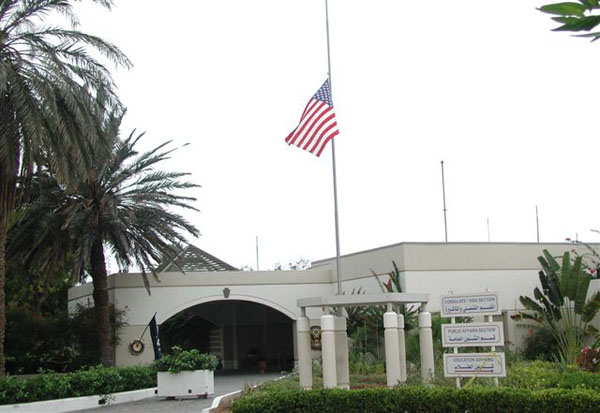
In Jeddah on December 6, 2004, AQSA finally struck again. This time, the jihadists attacked the US Consulate [1]. In the early hours of that Monday morning, five extremists led by Fayez Awad al-Jehani, under orders from AQSA, approached a side entrance to the Consulate as diplomatic cars prepared to enter [1,2]. Jehani, the month prior, had lost three cousins in battle in the vicious circumstances of Fallujah, Iraq, and this was no doubt on his mind as he approached the gates [3]. Jehani was a former member of the Saudi religious police, the Commission for the Promotion of Virtue and the Prevention of Vice, and had no jihadist experience abroad [2]. When the gates opened, the men threw grenades and opened fire, forcing their way into the compound [1,2]. The assailants exited their Nissan at the precise time the diplomatic cars were moving through the checkpoint, forcing the gates to remain open [1,2]. However, because the gates were blocked, the militants were forced to move in on foot [2]. They pumped bullets into the vehicles, wounding several prior to entering the compound [1]. One American, Vice Consul Monica Lemieux, was in one of the cars, but was pulled to safety by a Yemeni employee at the Consulate [1,2]. Lemieux had been wounded in the shoulder, but in the end no Americans died in the attack [1,2]. One of the raiders was actually killed entering the gate [2]. It appears that this casualty was Fayez al-Jehani, killed by a Consulate guard from Sri Lanka who himself also lost his life in the engagement [4]. Once inside, the attackers tore down the American flag, setting it ablaze [1,2]. Grenades were then used on a portion of the compound believed to house US Marines [1,2]. They were reportedly firing and moving precisely as if they had been very well trained for combat [1]. They moved frighteningly fast and with temerity indicative of much preparation [1]. However, while being well trained in arms and violence, they seemed to have little knowledge as to the layout of the compound or the locations of their American targets [2]. Thus the attackers lost valuable time to conduct their violence [2]. Meanwhile, the Saudis forced their way into the compound and engaged Jehani and his men [1,2]. They set up positions around the Consulate to prevent escape and posted snipers in an attempt to end the rampage as early as possible [1,2].
The attackers took hostages for a brief period of time, attempting to use them as human shields [1,2]. In addition to some wounded, the attack left a Sri Lankan, Pakistani, Yemeni, Sudanese and Filipino dead [1]. The Sri Lankan was the gate guard while the other four were employees from inside the Consulate [1]. The Saudi security forces suffered some wounded men, while the American staff only had two wounded in the end, including Vice Consul Lemieux [1,2]. Luckily as mentioned, the Saudi forces responded promptly, entering the compound and setting up their perimeter [1,2]. Jehani was killed along with three of his men including Eid Dakheelallah al-Jehani and Hassan Hamid al-Hazimi [1]. The forces stormed the area where the hostages had been held for around an hour and a half, and put an end to the threat [1,2]. A fourth militant who was wounded, captured and later succumbed to his wounds was not identified [1]. The fifth militant, although known by security forces when captured, had his identity withheld [1]. Another militant named Turki al-Hazimi was later declared to be an attacker as well as being Jehani’s cousin. He may well have been related to the above mentioned Hassan al-Hazimi and was probably the fourth militant killed [5]. Although this was not a spectacular mass casualty event for AQSA, it shook the Saudi and American sense of security, diverted massive amounts of resources to protect vulnerable points of interest, and yet again pushed AQSA back into public awareness in the Kingdom and beyond.
The next day, AQSA claimed credit for the attack saying, “this operation comes as part of several operations that are organized and planned by al Qaeda as part of the battle against the Crusaders and the Jews, as well as part of the plan to force the unbelievers to leave the Arabian Peninsula [6].” They also stated that the militants had “managed to enter one of the crusaders’ big castles in the Arabian Peninsula and managed to enter the American consulate in Jeddah, in which they control and run the country [6].” US President Bush cited the quick response of the Saudis in taking control of the situation, and the Saudis themselves cited yet another example of the devious and nefandous nature of the insurgency [1]. At least four additional consular employees were wounded, yet fortunately the death toll was low considering the five well trained jihadists had held up to eighteen hostages and were incredibly well armed [1]. AQSA declared victory nonetheless. They claimed credit under the title of “Al-Qaida in the Arabian Peninsula,” offering another example of the development of that particular appellation [6]. While inside the consulate, the militants had called authorities referring to themselves as the Fallujah Brigade, a clear reference to Jehani’s desire to obtain revenge for his losses in that particular battle [7]. Saud al-Otaibi had released an audio message shortly after his appointment as AQSA commander, vowing to perpetrate more attacks, and just a month after the release, he had succeeded [8]. While Otaibi implores Muslims to join the jihad in the Arabian Peninsula, Iraq, or elsewhere, he also pays respect to several important deceased members of AQSA including Muqrin, Faisal al-Dakheel, Yusef al-Ayiri, Khalid al-Hajj, and others. He conspicuously leaves out the name of Saleh al-Awfi, providing further hints at the time that the primary militant leader was still alive and functioning [8].
New Year’s Onslaught
As for the remainder of December, AQSA found itself involved in an immensely bloody struggle at the end of the month. On December 29, 2004, Otaibi, Awfi, and their men attempted to end the year with ostentatious twin suicide bombings of both the Ministry of the Interior and the headquarters of the Special Forces Units to the east of Riyadh [9,10]. These two entities were at the forefront of combatting AQSA. The resulting chaos and battle along with a firefight the night prior led security forces to a plethora of AQSA fighters and leadership [9,11]. The bombings which spurred the massive running street battle were an attempt on the life of the man in charge of hunting the jihadists: Prince Naif [9,12].

The suicide bombers were led by Abdullah al-Subayi (B-10), the ruthless militant who had participated in the siege of the Oasis Compound in Khobar [10], and they described themselves as the Muqrin Brigade [13]. He personally led the attack on the Ministry of the Interior [10]. This facility was targeted due to the fact that it was this government Ministry that was overseeing the search for the wanted jihadists and contained the offices of Prince Naif himself [12]. The ministry had been mostly responsible, along with the courageous efforts of Saudi and American intelligence and security, in bringing down the network and its members. Each of the bombings used well over a ton of explosives and was intended to cause maximum damage [12,14]. Certain factors played in forcing the resulting toll to be incredibly small. It could be that AQSA was purposefully trying to avoid killing bystanders as this was the primary point of debate over their actions in the jihadist circles and beyond [15]. It was initially reported that one taxi driver was killed in the Interior ministry blast and no one at the Special Forces Units HQ and training center [11]. However, later reports by the Interior Ministry indicated that there were no civilian deaths whatsoever [10]. In the first bombing, Subayi and his men rammed the gate of the Interior ministry, engaged security forces, and then committed suicide when their vehicle was detonated [16]. The building was heavily damaged, but the attack occurred at 9 pm when most employees were out and street traffic was low [11,15]. Simultaneously in eastern Riyadh, two attackers took their suicide car bomb towards the entrance of the Special Forces Unit HQ, but were intercepted over 300 meters away [14,16]. They were forced to detonate prematurely [14,16].
Abdullah al-Subayi was dead, his long service with AQSA including his procurement of vehicles and explosives, his smuggling capabilities, and his dramatic participation in the both the Muhaya and Khobar attacks, was over [9,10]. Saudi forces had been straining to discover his location before he could perpetrate a bombing such as the one at the Interior Ministry. Luckily, Subayi’s efforts that day were in vain, as the casualty count was incredibly low and his overall target was unharmed [12,15]. Subayi had originally planned, as part of a group that included militants Mosaed al-Subayi and Abdullah Sultan al-Otaibi, to wage jihad in Iraq [17]. Instead he was recruited by Abdulmuhsin al-Shabanat to join the ranks of AQSA and began his jihadist career in his homeland [17]. Subayi had mutilated the bodies of victims in the Khobar massacre and helped prepare the vehicular bomb used in the Muhaya attack [9,10]. Subayi had achieved martyrdom, but AQSA had clearly lost the experience and potential of yet another devoted militant. Mohamed Muhsin Rashid al-Osaimi perished along with Subayi in the attack [9,10]. The young man was only 22 years old when he died in the Interior Ministry bombing [9]. Osaimi was previously detained when authorities learned of his connections with AQSA [9]. They feared he was preparing to travel and fight abroad at their behest, most likely in Iraq [9]. Security forces prevented his leaving and he promised to return home and not participate in jihadists actions [9]. His family was to have watched him closely and kept him at home [9]. Unfortunately the young man left again, and while not being able to wage jihad abroad, he was persuaded by AQSA to remain in the Kingdom. The last militant killed with Subayi in the blast was Ismail Ali Mohamed al-Khuzaim, who was wanted for his participation in the tracking, abducting, and murdering of Paul Johnson [14]. As for the two suicide bombers at the Special Forces base, they were Dakheel Abdulaziz Dakheel Mohamed al-Obaid and Nasir Ali Saad al-Mutairi [9,10]. Obaid was involved as well with the Johnson abduction and murder, and was one of the individuals who had amputated the leg of Nasir al-Rashid with a power saw [9]. Mutairi on the other hand was not implicated in those crimes but had been a close associate of ideologue Abdulmajid al-Muni before his death [9]. He was also known for helping cover the tracks of the militants as they ran from the ever persistent Saudi and American search [9].
The Kingdom Retaliates
Tuesday night, the evening before the bombings saw Saudi forces engaging AQSA militants in a Riyadh car chase battle that abruptly ended at a gas station [9,11]. Three militants were killed in this engagement according to initial reports, but the Interior Ministry later said only one militant had perished [9,11]. Those being chased were connected to the following day’s events [11]. After the 9 pm explosions on the 29th, security forces were able to trail the AQSA militants involved due to evidence from the previous day’s engagement and presumably from the explosions themselves [11]. By 10 pm, on the 29th, Saudi security forces were amidst a heavy exchange of gunfire with the militants in the Tawun suburb of Riyadh [9,11]. The raided villa to which the militants had been tracked soon spilled forth with gunmen. At the end of the running gun battle, many additional jihadists lay dead [9,11]. In total, the engagements killed ten militants [9,11]. AQSA was revealed to have taken a severe blow to their ranks and leadership over these violent two days.

After the dust settled on the firefights, the Saudis took stock of what they had managed to accomplish. The Al-Qaida hideout they had descended upon was home to Sultan Bajad al-Otaibi and Bandar al-Dakheel [9,11]. Although these men and their cohorts attempted to escape and fight their way through the cordon, the Saudi forces refused to allow another situation where the men eluded them [11]. Sultan Bajad al-Otaibi, a man who wrote pamphlets that justified the killings of other Muslims as well as ‘infidels’ was left dead on the street [11]. The militant had been involved in the Muhaya attacks, some foiled attacks, and many other incidents [9]. His role as ideologue for the group was important in bringing in new recruits and giving explanations to them for their crimes [9,18]. He had participated in fundraising for the group and was involved with propaganda releases, such as Sawt al-Jihad [18]. Like most of the other ideologues however, he had no experience in jihad abroad [18]. Khalid Ahmed Mohamed al-Sinan has been previously mentioned as a senior lieutenant for Muqrin and a trusted member of the network [9]. His participation in the Muhaya attack was well known [9]. He had fought in Afghanistan and trained the younger AQSA members from his experience [9]. Sinan was mortally wounded in the shootout [108,110/9,11]. Deceased with him was Badr Mansur Badr al-Subayi, another lieutenant for Muqrin and participant in the previously mentioned operations [9]. Subayi was of a rank in the organization that held him just below the level of Awfi and Otaibi [9]. His experience both inside and outside of the country made him invaluable [9,19]. Subayi had fought in Bosnia as well as Afghanistan in the 1990s [19]. Upon return to the Kingdom he was incarcerated in the notorious prisons of Hair and Dammam for four years [19]. When he was released in 2002 he rejoined jihad, this time in his home nation [19]. Ibrahim Ahmed al-Rimi, the Yemeni who was a deputy to Khalid al-Hajj and later a deputy to Sultan Bajad al-Otaibi, was also killed in the exchange [9,11]. Rimi was the only non-Saudi militant killed this day [11]. He was known for enabling communications between the militants in the Kingdom and had been a fighter in Afghanistan [9,11]. Thamir Khamis Abdulaziz al-Khamis was brought into the group due to his computer knowledge and ability to assist the group in building web sites [9]. He was in charge of much information for the group and equally met his fate over these two days [9]. Saud Abdullah Saadan al-Jaadi, who was known for rigging vehicle explosives, finally met his own end in these battles as well [9]. He had been important for Muqrin for this reason and had continued to be of value for Awfi. Two of the five attempted car bombings in April of 2004 had actually used vehicles registered to Jaadi [9]. He had also delivered the car used in the Traffic Directorate bombing to Muqrin [9]. Recent AQSA recruit Mohamed Sulaiman Ibrahim al-Wakeel was killed in the battles [9]. Wakeel’s wife Haila al-Qusayir was also dedicated to the extremist cause and would harbor a deep hatred for Saudi authorities due to her husband’s death, leading to her eventually becoming an active member of the organization [20]. While Wakeel was a new face to the cause, veteran AQSA fighter Mohamed Abdullah Saleh al-Muhsin died with his leaders as well in those late December firefights [9]. Abdulwahab Adel Abdulwahab al-Shareedah was a henchman and logistician for Sultan Bajad al-Otaibi and perished with his boss in the streets [9]. Finally, Bandar al-Dakheel was killed by the Saudi security forces, putting an end to his involvement in the crimes of the terror organization [9]. He had last been involved in a skirmish in Uniza, Qasim province on November 16, 2004, which had resulted in the death of a security force member and the arrests of a handful of militants [21,22]. Bandar joined his brother Faisal in a death acquired in the name of jihad.

Despite the severe loss of life suffered by AQSA, on December 31, 2004 they claimed the attack with pride [12]. The vainglorious release named the attack for what it was supposed to be, an attempt on Prince Naif, the Minister of the Interior, his family and associates [12]. The incident did not come close to killing Naif, but this would not be the last time AQSA would try to kill the Prince or his son. The AQSA statement reveled in delusion: “A brigade prepared a complex operation to kill the head of apostasy in the Arabian Peninsula, (Interior Minister) Naif bin Abdulaziz, his son and entourage and also striking the headquarters of the emergency forces [12].” It added falsely that, “A number of crusader trainers were killed in the training headquarters and several of the forces were wounded [12].” The group attempted to show resiliency by adding, “We are determined to regroup and prepare unique operations to expel the polygamists, infidels, Jews, and the Christians from the Peninsula of Prophet Mohammed [12].” Prince Naif, Crown Prince Abdullah, King Fahd, and the general populace had in reality shown the most resilience, although 18 people had been wounded in the attacks [12]. The Saudis’ ability to remain standing was directly linked to the killing of so many AQSA militants who were important members of the organization. List B now only contained six names, although the Saudis weren’t sure if Awfi was alive or not, due to previous reports of his death [23]. The Saudis went back on the propaganda offensive within the periodicals and on television. Prince Naif’s son Ahmed, also a member of the Interior Ministry, vowed to eradicate terrorism and deviancy itself in comments which were televised [12].
They also televised statements by captured militants on their treatment in Saudi prisons, including the notorious al-Hair. In an airing on the prison in December, the authorities went so far as to suggest that the militants who surrendered lived in luxury [24]. This of course is far from the truth, but the Saudis needed to ensure that young impressionable militants would feel at ease surrendering or being captured, and to do this they created a mythical Saudi prison setting. Perhaps then the young men would hesitate to fight to the death. One surrendered militant, Fikri Faqih (it is unknown for what AQSA crime he was wanted), declared that there was no torture in the prison and that he should have surrendered sooner due to these favorable conditions [24]. Despite the spirited program, nothing was going to dissuade the fiercest AQSA militants from their insurgency.
Speaking from the Shadows
The AQSA militants continued to be put on the defensive. The Saudis appeared to be on a full offensive, making raids and arrests as the year 2005 began. On January 9, 2005 for instance, the Saudis conducted a raid in al-Thuwarait, north of the al-Zulfi Governorate [25,26]. The operation recovered numerous weapons and supplies used by the militants [26]. Also, four militants were killed when they resisted against the raid, including some interesting characters [25,26]. It happened that these men had fled from the Tawun shootout in December [27]. Mohamed Abdulrahman Mohamed al-Farraj (the militant who had been with Khalid al-Subait during the Fahya shootout [27]) was related to Khalid al-Farraj and had in fact participated in the ambush of security forces at Khalid al-Farraj’s residence back in January of 2004 [25,26]. Mohamed al-Farraj was also involved in transporting weapons and cars prior to his death, including the transportation of one of the attempted April car bombing vehicles [25,26]. Mishaal Obaid Abdullah al-Hasri was wanted for the killing of two highway security patrollers and for involvement in the Johnson beheading [25,26]. Omar Abdullah Saad al-Raed al-Qahtani had been the militant sheltering Faris al-Zahrani in Abha [25,26]. The fourth militant killed was not identified [25,26]. These three men, although not on List B, were yet another loss to AQSA, and despite escaping the December fire storm, could not avoid justice overall.
The next major clash did not come until March, when three militants came to al-Rabwa district in Jeddah and asked Saad al-Youbi, a security force member to hide them in his apartment [28]. Following a tip, security forces surrounded the building and attacked in the early morning hours [28]. The militants and security forces engaged in a gun battle which killed Saad al-Youbi and one female bystander who was attempting to flee the building with her son and husband [28]. The son and husband were wounded but survived [28]. At least five security forces were also wounded, in addition to the bystanders [28]. Ibrahim al-Youbi, one of the militants, was wounded and captured while his two remaining cohorts were also arrested [28,29]. The security forces had surrounded the building and entered with impressive force [29]. The two other captured militants were reported as Ibrahim Al-Youbi’s brother and uncle [29]. By conjecture it can be assumed that Saad was also a member of the family. Although none of the men were on List B, the significance can be easily seen. Ibrahim had a link directly to the security forces via Saad. Saad was influenced enough by the AQSA militants to hide them, fight for them, and even die for them. Despite the implication that the remaining AQSA leadership could be spirited away by their nation’s own security forces, the Saudis soon came closer to ending the war against the List B members. During the spring of 2005 the Saudi forces clashed in the most arduous firefight against AQSA forces in the two year campaign thus far [30].
The battle was preceded by the answering of an important question on the minds of the Saudis: what was the fate of Saleh al-Awfi? On March 16, 2005 it was finally revealed that the militant overseer was still alive [31]. An audio recording of Awfi was released, and in it he promised solidarity with the fighters of al-Qaida in Iraq [31]. Awfi asseverates that his group will assist Abu Musab al-Zarqawi, the leader of AQI, in any way possible and even promises to send fighters [31]. Awfi asserts that together, the two branches of al-Qaida cannot be broken [31]. Awfi implores the jihadists of the surrounding Arab nations of Qatar, Oman, Bahrain and others to take up arms against the American military presence on the Peninsula [31]. With Awfi alive, it meant positively that six men remained on List B. The Saudis thus entered into battle with the intent of destroying AQSA once and for all.
The next Chapter, the final of the Segment, brings us to the Battle of al-Ras, a ferocious siege upon the militant prey from their Saudi predators. The circumstances and personalities involved in the engagement will be explored, as the Kingdom hoped to force finality upon a seemingly infinite cycle of violence.
CITATIONS:
- [1] Ain al-Yaqeen News Magazine, December 10, 2004, http://www.ainalyaqeen.com/issues/20041210/feat2en.htm
- [2] JTIC Briefing: Jeddah attack underscores fall in capabilities of Saudi militants, by Michael Knights, Jane’s Terrorism and Insurgency Center, The Washington Institute for Near East Policy, January 2005, http://www.washingtoninstitute.org/policy-analysis/view/jtic-briefing-jeddah-attack-underscores-fall-in-capabilities-of-saudi-milit
- [3] Jihad in Saudi Arabia, Thomas HegghJihad in Saudi Arabia: Violence and Pan-Islamism since 1979, Thomas Hegghammer, Cambridge University Press, 2010, p. 192
- [4] Path of Blood: The Story of Al-Qaeda’s War on the House of Saud, Thomas Small and Jonathan Hacker, Simon & Schuster UK, 2015
- [5] Jihad in Saudi Arabia, Thomas HegghJihad in Saudi Arabia: Violence and Pan-Islamism since 1979, Thomas Hegghammer, Cambridge University Press, 2010
- [6]Al-Qaida linked group takes credit for Saudi attack, CNN News, December 7, 2004, http://www.cnn.com/2004/WORLD/meast/12/06/jeddah.attack/
- [7] Saudis blame “Fallujah Brigade” for US Embassy attack, Agence France-Presse, December 7, 2004, http://www.abc.net.au/news/2004-12-07/saudis-blame-fallujah-brigade-for-us-embassy-attack/598398
- [8] Speech by Saud Hamud al-Otaibi, Commander of al-Qaida in Saudi Arabia, Flashpoint Partners, November 3, 2004, https://flashpoint-intel.com/inteldocument/saudi1104-2.pdf
- [9] Ain al-Yaqeen, January 7, 2005, http://www.ainalyaqeen.com/issues/20050107/feat2en.htm
- [10] Most wanted Terrorist among five Riyadh car bombers, by Abdul Wahab Bashir, Arab News, January 2, 2005, http://www.arabnews.com/node/260405
- [11] Two most wanted terrorists killed, by Raid Qusti, Arab News, December 31, 2004, http://www.arabnews.com/node/260312
- [12] Al-Qaida: Riyadh attacks targeted interior minister, January 5, 2005, The Daily Star, http://www.dailystar.com.lb/News/Middle-East/Jan/05/Al-Qaeda-Riyadh-attacks-targeted-interior-minister.ashx#axzz2XcvOlkJC
- [13] Jihad in Saudi Arabia, Thomas HegghJihad in Saudi Arabia: Violence and Pan-Islamism since 1979, Thomas Hegghammer, Cambridge University Press, 2010
- [14] Tons of explosives used in Riyadh bombings, Arab News, January 4, 2005, http://www.arabnews.com/node/260512
- [15] Saudi militants bomb security sites in capital, by Megan K. Stack of the Los Angeles Times, for the Chicago Tribune, December 30, 2004, http://articles.chicagotribune.com/2004-12-30/news/0412300228_1_seven-gunmen-were-shot-main-riyadh-thoroughfare-day-after-saudi-forces
- [16] Car-bombings, gun battles rock Riyadh, Al-Jazeera News, December 30, 2004, http://www.aljazeera.com/archive/2004/12/2008410135017237450.html
- [17] Jihad in Saudi Arabia, Thomas HegghJihad in Saudi Arabia: Violence and Pan-Islamism since 1979, Thomas Hegghammer, Cambridge University Press, 2010, p. 197
- [18] AQSA Publication, Sawt al-Jihad, no. 5
- [19] Biography of Badr Mansur al-Subayi, Al-Qaida militant recently killed by Saudi security forces, Flashpoint Partners, January 12, 2005, https://flashpoint-intel.com/inteldocument/saudi0105-2.pdf
- [20] AQAP’s growing security threat to Saudi Arabia, by Caryle Murphy, Combating Terrorism Center at West Point, CTC Sentinel, June 3, 2010, http://www.ctc.usma.edu/posts/aqap%E2%80%99s-growing-security-threat-to-saudi-arabia
- [21] Sawt al-Jihad, no. 29
- [22] Saudi Arabia: National Security in a Troubled Region, Anthony Cordesman, Praeger, 2009, p. 56
- [23] Al-Qaida in Saudi Arabia names new leader, by Raid Qusti, Arab News, November 4, 2004, http://www.arabnews.com/node/257575
- [24] Saudis use the hard sell for their soft cells, by Roula Khalaf, NBC News, December 16, 2004, https://www.nbcnews.com/id/wbna6722863
- [25] 9th January 2005-Identities of deviants killed by security forces, Saudi Press Agency, January 9, 2005, http://www.saudinf.com/display_news.php?id=2476
- [26] Ain al-Yaqeen, January 14, 2005, http://www.ainalyaqeen.com/issues/20050114/feat3en.htm
- [27] Path of Blood: The Story of Al-Qaeda’s War on the House of Saud, Thomas Small and Jonathan Hacker, Simon & Schuster UK, 2015
- [28] Two killed in Jeddah gunbattle, aby Samir al-Saadi and Abdul Maqsood Mirza, Arab News, March 14, 2005, http://www.arabnews.com/node/263712
- [29] Ain al-Yaqeen, March 18, 2005, http://www.ainalyaqeen.com/issues/20050318/feat4en.htm
- [30] Saudi forces kill 3 most wanted militants, Associated Press, April 6, 2005, http://www.foxnews.com/story/0,2933,152592,00.html
- [31] Audio Statement from al-Qaida in Saudi Arabia to Abu Musab al-Zarqawi, Flashpoint Partners, March 16, 2005, https://flashpoint-intel.com/inteldocument/saudi0305.pdf
© Copyright 2024 Nolan R Beasley
 Chronicles in Zealotry