
SEGMENT I – Foundations In A Franchise Of Fear – CHAPTER 1 – Origins and the USS COLE
For the entirety of the Series, please see – https://chroniclesinzealotry.com/fugitives-of-the-peninsula/
The Series Fugitives of the Peninsula will detail the evolution of al-Qaida cells in Yemen and Saudi Arabia into the terror franchise Al-Qaida in the Arabian Peninsula (AQAP). In this first Segment of the series, we focus on the establishment of these al-Qaida cells within the Arabian Peninsula. In this first specific chapter, we aim to examine the particular unit of al-Qaida operatives which conducted the USS COLE attack and their respective histories.
Read more: SERIES: Fugitives Of The Peninsula – (Chapter 1 – Origins And The USS COLE)As Yemen Transforms Into A Theatre Of Terror
Along an empty stretch of road in tribal Yemen, a sport vehicle, with its seven occupants, drove rapidly forward to an unseen destination. Unbeknownst to them, they were pursued by a deadly and lifeless machine. Within the vehicle, an Al-Qaida/Yemeni tribal point man connected to the USS COLE bombers, an American citizen who had attempted to enlist others to his malevolent cause, four of their bodyguards, and a former Yemeni intelligence officer were being targeted for death [1-5]. In a few moments the intelligence officer was flung to safety while the others died ablaze in twisted metal [4]. The men were killed when their vehicle was destroyed by a Hellfire missile [1]. A Predator drone soared overhead, surveying the wreckage, having accomplished the first heavily reported mechanical assassination of the so-called ‘War on Terror’ and perhaps, but unlikely, the first assassination of an American national by the CIA [5].
Untold miles away, the CIA celebrated their victory. They had outfitted this reconnaissance drone with Hellfire missiles for purposes of state sponsored assassination and they had succeeded. They would attempt to account for their covert mission by having the Yemenis claim responsibility for the incident, but the Defense Department would blow the cover and reveal that the assassination was the result of a drone strike [6]. It is important to note that this original strike against Al-Qaida in the Arabian Peninsula and the resulting casualties were initially viewed as instrumental in dismantling the group’s presence therein. However, it would eventually be seen that the Al-Qaida roots in the Peninsula went much deeper than originally thought. To understand the origins of Al-Qaida in the Arabian Peninsula (AQAP), the group must be viewed from its senior leadership down. Therefore, it must also be viewed beginning with the time of the US Embassy bombings in Africa.
The Embassy bombings in Nairobi and Dar Es Salaam on August 7, 1998 are two of the best-known Al-Qaida operations. We will not delve into the details of these attacks, their planning, or the overall crews who perpetrated them but rather succinctly focus on a couple of individuals involved with them who have bearing on the story of AQAP. To understand these individuals, one must first take a look at the Nairobi suicide attackers. The two men who would train to be suicide bombers in the Nairobi attack were Mohamed Rashid Daoud al-Owhali, of Yemen and Jihad Mohamed Abdah Ali Abdullah al-Harazi, of Saudi Arabia [7]. Harazi was also known as Azzam and was the cousin of a man known as Mullah Bilal al-Makki [8-10]. Mullah Bilal’s real name was Abdulrahim Hussein Mohamed Abdah al-Nashiri [8,9]. Nashiri was a known Al-Qaida operative whose services the organization had actively sought after. He had been implicated by the Saudis in early 1998 of attempting to smuggle Sagger anti-tank missiles into the country from Yemen to be used in an attack against American interests [10]. This is where the US first began to hear about this man [11]. Nashiri would help his cousin obtain a false passport, vouch for him and Owhali to bin Laden, and help train the men for martyrdom [12]. The two would then be tapped by bin Laden as the suicide bombers for the Nairobi mission [13]. Interestingly, Azzam was killed in the explosion but Owhali survived after he leapt from the bomb laden vehicle and engaged Kenyan security at the Embassy [14]. After his eventual capture Owhali identified Nashiri to American investigators [11]. It was at this point that the latter was suspected of involvement with Al-Qaida. Around this same time, Owhali and other witnesses reported that Nashiri and Al-Qaida were planning to attack vessels in the Gulf of Aden off Yemen [11]. Nashiri was however, still believed to not have a very pertinent role in the organization [11]. This is probably mostly due to his hesitancy to fully swear fealty to bin Laden [10]. This fact aside, Nashiri would be in charge of one of Al-Qaida’s crowning achievements: The USS COLE bombing, as well a series of attempted maritime attacks. After hearing of his cousin’s successful martyrdom, Nashiri finally swore a bayat or blood oath to bin Laden and officially joined the organization [9].
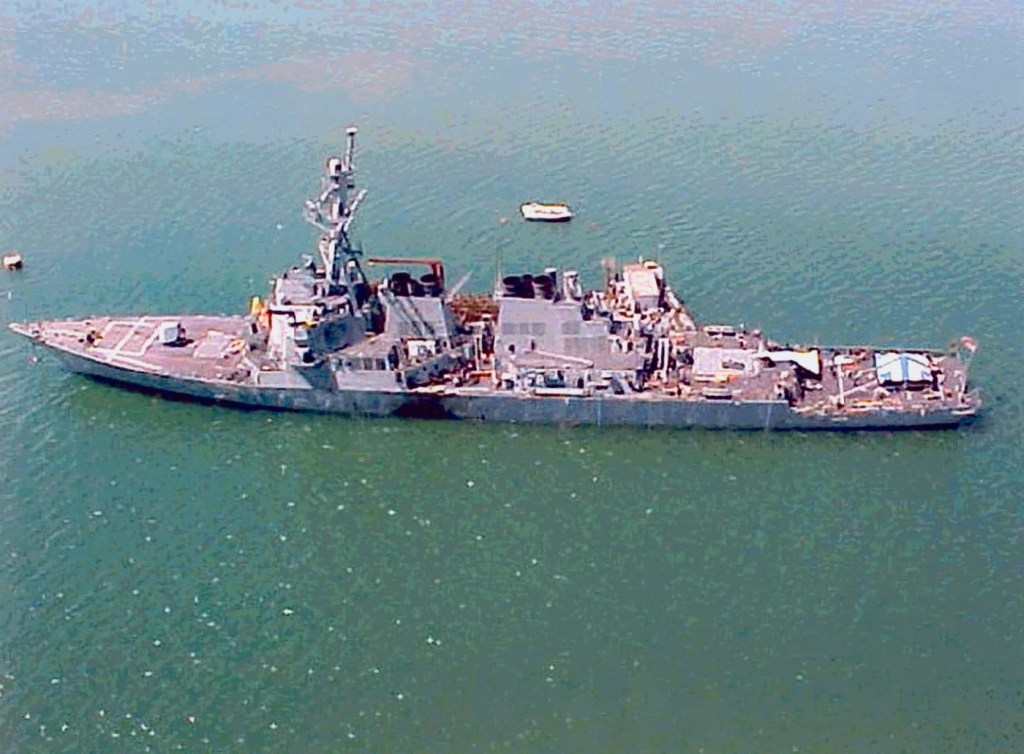
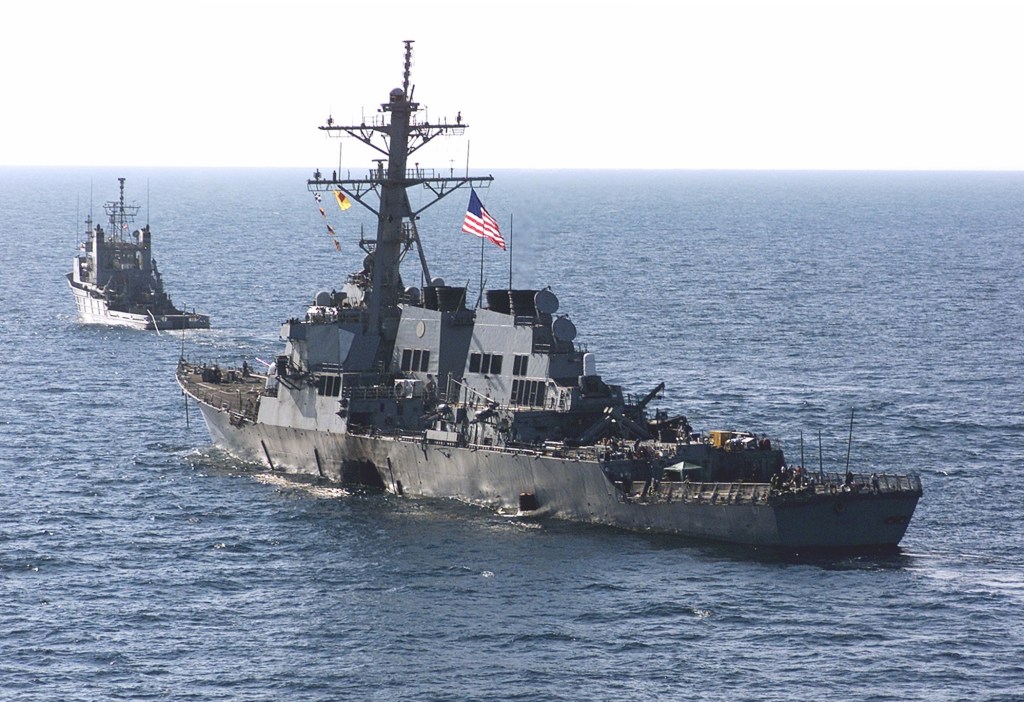
On October 12, 2000 as the guided missile destroyer USS COLE DDG 67 pulled into port in Aden, Yemen for refueling, a small boat laden with explosives pulled up alongside of it. The two men on the vessel, Ibrahim al-Thawar (known as Nibras) and Hassan Said Awad al-Khamri (known as Abdullah al-Musawa) waved to the sailors onboard the COLE prior to detonating their ship and gouging a huge hole into the side of the destroyer [15,16,8]. In all, seventeen sailors were killed that day, and the warship nearly sank. Nibras and Khamri worked for Nashiri as part of his Al-Qaida network in Yemen. This attack helped lay the groundwork for what would become AQAP. A wealth of knowledge on the incident and its perpetrators is offered in the tome The Black Banners, by former FBI Special Agent Ali Soufan, who actually investigated the crime in Yemen.
The Bin Laden Lieutenants Nashiri And Bin Attash
Nashiri had waged Jihad in Tajikistan and along the front lines in Afghanistan, fighting for the Taliban by the mid-1990s [9]. Herein he began to make contacts within the Al-Qaida leadership, and trained at the Jihad-Wal camp in Khost in 1993 [9]. At one point in 1994 he met bin Laden and upon listening to his lectures, became heavily influenced by them [9]. In 1996 after a failed venture to Tajikistan with a small group of Mujahideen dubbed the “Northern Group,” Nashiri was reintroduced to bin Laden who had just relocated his operations from Sudan to Afghanistan [9,10,17]. Owhali and Harazi were also members of this failed Tajikistan sojourn [17]. The leader, or Emir, of al-Qaida wanted members of the Northern Group to swear a bayat to him and form the beginnings of his new network in Afghanistan [17]. Nashiri initially declined although he later continued to fight with bin Laden’s Brigade 55 (an entirely Arab fighting force under bin Laden that acted as a specialist armed unit for the Taliban [18]), and even contracted malaria during his service [9,10]. Al-Qaida leadership took note of the man and continued to desire his abilities.
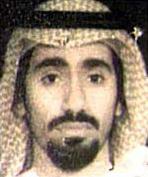
As mentioned, after his cousin Jihad’s death, Nashiri officially joined with bin Laden [9]. Nashiri though, had been acting on bin Laden’s orders before this point, attempting to smuggle the anti-tank missiles into Saudi Arabia and then later casing and preparing for the maritime attack that was the COLE bombing [10,19]. In 1998 bin Laden had sent Nashiri to case a northern port of Yemen for US naval ships, but after finding nothing and reporting to his emir, the decision was made to focus on southern the port of Aden [10,19].
Simultaneously, a man who was extremely loyal to bin Laden and his cause was also casing targets in Yemen. Walid Mohamed Saleh bin Attash (aka Tawfiq bin Attash aka Khallad), was a very young bin Laden follower who found himself with an incredible amount of responsibility within the organization [19,20]. It was said that no one got to bin Laden but through bin Attash [19,20]. His family had solid al-Qaida ties, as his father Mohamed had been a confidant of bin Laden and other mujahideen who had fought against the Soviets in Afghanistan [20]. His brother Hussam had been a close bin Laden supporter in the 1990s, and was known within the organization as Mohanad [19,20]. The eldest bin Attash brother had helped organize the Northern Group and had brought the men to bin Laden [19]. Walid had been on this excursion and had become friends with Nashiri [19]. Both Mohanad and Walid had sworn bayat to bin Laden upon his transplant of operations into Afghanistan [19,20]. Two of Walid’s younger brothers, Hassan and Abdulaziz, would train with and join Al-Qaida as well [19,20]. It was while in battle with his brother Mohanad that Walid bin Attash was transformed from an al-Qaida footsoldier to an al-Qaida up and coming commander. The bin Attash’s were engaged with bin Laden’s Brigade 55 and the Taliban, fighting against the Northern Alliance at Murad Beg along the front lines north of Kabul. The battle resulted in Mohanad’s death and Walid (hereafter referred to as bin Attash) being seriously wounded [19,20]. Their younger brother Abdulaziz (known as Abdulbarah or Abu al-Bara) was lost in the battle and had to be rescued via helicopter from behind Northern Alliance lines [19]. Bin Attash was sent for medical attention, but his left leg was eventually amputated from the knee down [19]. His prosthetic leg was ill fitting and painful which apparently led to depression in the young man [19]. Upon receiving a congratulatory and apparently uplifting letter from bin Laden while he was recovering in Pakistan, the impressionable Yemeni made the decision to rejoin the ranks of al-Qaida and completely dedicate his life to the cause [19].
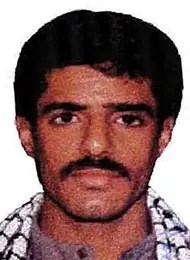
It was 1997, and bin Attash became a bin Laden bodyguard, protecting the emir and running important errands for the man [19]. Bin Attash also performed services for other important al-Qaida leaders such as Mohamed Atef and Saif al-Adel (Sobhi Abu Sitta and Mohamed Salehuddin Zaidan respectively, the military leaders of Al-Qaida [21,22]) [19,20]. As mentioned his importance grew within the organization and soon, he was helping select the composition of bin Laden’s ever rotating team of security [19,20]. He was essentially one of their leaders and it was through him that jihadists would receive personal talks and meetings with their emir. Soon bin Laden began to trust bin Attash with operational duties [19,20].
Bin Laden soon became entranced with the idea of attacking ships within the ports of Yemen [19,20]. Yemen was essentially selected due to lack of security, ease in acquiring weaponry, and ease in smuggling fighters to and from the country. Bin Attash, who was a native Yemeni, was selected to participate in the operation [19,20]. His first and foremost duty was to case the ports in Yemen that bin Laden had selected. In fact, bin Laden sent bin Attash to case three different ports in the southern part of the country, including Aden [19,20]. Bin Laden had discussed the possibility of attacking oil tankers and aircraft carriers, but the massive cost and coordination of such an operation would greatly decrease its chances of success [19]. Bin Laden and bin Attash settled on the idea of attacking a US Navy destroyer as it refueled in one of Yemen’s ports [19,20].
As can be seen, bin Laden had sent two operatives to begin the process of the impending attacks. Nashiri and bin Attash (at this point known as Khallad, Arabic for Silver, within al-Qaida ranks) were each casing differing territories, but resided at the same al-Qaida guesthouse within the country on occasion. The guesthouse was in Sanaa and was known as the Bait Habra [19]. Another such guesthouse was also a communications center for the group and was run by Ahmed al-Hada and his family [23]. We will discuss Hada, his guesthouse and his family in detail later. Once aware of each other’s existence and mission, bin Attash and Nashiri knew that bin Laden was conducting the mission with full resources committed. The two continued their vigorous research, checking on the purchasing of vessels, and came to the same conclusion. Once they reported to bin Laden it became obvious that Aden was the preferred choice of target [19].
It was at this time that Nashiri assisted Owhali and Harazi to obtain fraudulent passports and went to Afghanistan to aid in their martyrdom training. Actually, both Nashiri and bin Attash left Yemen for Afghanistan and helped the men prepare for their impending attacks [12]. Interestingly, the man who would be responsible for the building the Embassy attack bombs, Muhsin Musa Matwali Atwah (Abdulrahman al-Muhajir), would also eventually help train Nashiri with explosives [24]. After the Embassy bombings mission was completed and Nashiri joined al-Qaida, both he and bin Attash were sent on a return mission to Yemen where they would refocus their entire energies towards attacking a US Naval vessel refueling in Aden [25].
The Developing Plot And THE SULLIVANS
Bin Attash set up a crew in Yemen and became primarily involved with acquiring explosives for the attack. To do so he brought into the fold a man named Hadi Mohamed Saleh al-Waeli, a well-known Yemeni arms dealer. Waeli, known as Hadi Dulqum, helped acquire a very large amount of explosives for bin Attash [25]. Also, bin Attash reconnected with a jihadist he had fought beside of in Afghanistan named Jamal Ahmed Mohamed Ali al-Badawi [25]. Badawi knew the port of Aden well and his help would be crucial to the success of the operation. At the request of bin Attash, Badawi began the search for a purchasable fishing vessel in which to hide the bomb [25,26]. Bin Attash also counted an extremist fighter named Khalid Mohamed al-Jehani (Muawiya al-Madani [8]) among his crew, as well as Badawi’s own brother, Hussein [26]. Jehani and the Badawi brothers, Jamal and Hussein, conducted surveillance on vessels in and around the port to procure information on their movements [26]. Meanwhile, Nashiri had enlisted the help of two jihadists: Abdullah al-Musawa (whose real name was Hassan al-Khamri), a frequent patron of the Yemeni al-Qaida guesthouse Bait Habra, and a fighter named Taha Ibrahim Hussein al-Ahdal [26]. Both of them were jihadists who had fought in Afghanistan. Together these two groups gathered the information they needed for the attack [26].
Next there occurred a bizarre event in the annals of al-Qaida history in which bin Laden directly influenced a foreign government to act upon his will. At the request of Nashiri, bin Attash began to consider staging the explosives in a different location [26]. Bin Attash was subsequently arrested on the venture while in Hadi Dulqum’s car, loaded with explosives for the attacks. The Political Security Organization (PSO) of Yemen made the arrest and put bin Attash in a political prison [26,20]. Nashiri, thinking that the operation would be called off for certain and that he was in serious danger of arrest, fled the country with his men for Afghanistan [26]. Bin Laden himself never let the situation make him anxious. He immediately sent a letter to those he called his “Yemeni Brothers [26].” In fact, the letter ended up being read by General Ghalib al-Qamish, the head of the PSO, and President Ali Saleh himself [26]. The letter and its sender had a profound effect on the recipients. Bin Attash was released and the car returned complete with its illicit cargo [26]. Having been arrested in early 1999, bin Attash was liberated by May of the same year [8]. Upon his return to Afghanistan, bin Laden decided that bin Attash should not return to Yemen, but rather stay with him to focus on a much larger, grander operation in the works [26]. In fact, bin Attash had attempted to obtain a US visa on orders from bin Laden for this new operation [25].
Bin Attash was now fully involved in planning and preparing for the operation that evolved into the 9/11 attacks. Nashiri meanwhile took full command on the ground in Yemen of the Aden operation [26]. With the explosives moved into place, bin Attash sent his own men and cell members to work fully for Nashiri. This included a man named Salman al-Adani who along with one of Nashiri’s men, Taha al-Ahdal, were tapped by bin Laden as the operation’s suicide bombers [26]. Badawi was Nashiri’s point man in Aden now officially. He would eventually be given the task of video-taping the explosion for propaganda purposes. Badawi also bought and transported a ship for the attack from Saudi Arabia [27].
In August 1999, Nashiri leased a domicile in the Madinat al-Shab district of Aden, even installing a gate through which he could move the boat in and out of the courtyard for storage and usage [28]. In approximately September he transported a white boat into the port city of Hudaidah and parked it alongside the road by a fueling station, before hiring a truck to bring it to his courtyard in Aden [28]. Alongside Taha al-Ahdal (also known in court documents as Tahir Hussain al-Tuhami), Nashiri in November acquired a Yamaha motor for the boat while in Hudaidah [28].
Bin Attash was the liaison between Nashiri in Yemen and bin Laden in Afghanistan, while he busied himself training future 9/11 hijackers and other operatives [28]. He was personally preparing for his own martyrdom in a soon to be cancelled portion of the attacks that involved airline hijackings in Southeast Asia [20]. While bin Attash’s responsibilities had evolved, Nashiri’s still centered on successfully perpetrating the attack in Aden [29]. It is asserted by the 9/11 Commission that this attack was the only intended operation of what is known as the famed foiled Millennium attacks, to be directed by and perpetrated by al-Qaida hierarchy (while attacks planned in Los Angeles and Jordan were conducted by affiliates) [30]. Nashiri and his men obviously would have had no knowledge of any other operation occurring simultaneously to theirs. It is also very well possible that coincidence ordained that the next US destroyer to enter Aden just happened to sail in around the turn of the Millennium on January 3, 2000 [29].
That ship was the USS THE SULLIVANS DDG 68 [29]. Nashiri established his men for the strike. The previous December, Nashiri rented the upper story of a house in the al-Tawahi district overlooking the harbor [28]. While Nashiri and Khamri prepared to video tape the explosion for propaganda purposes, Adani and Ahdal attempted to launch their vessel and attack [29]. From the al-Haswah beach the boat from Madinat al-Shab was aimed at the refueling destroyer [28]. In the end, the vessel was too heavy due to being overladen with an excessive amount of explosives. The vessel became stuck in the sand and could not be moved, so it was abandoned by the failed suicide bombers [29]. The night time attack on the THE SULLIVANS was completely aborted. Nashiri was enraged at the bombers and later he, Adani, and Khamri discovered five Yemeni boys playing on the boat, handling the explosives [29]. Much to his dismay, Nashiri was forced to purchase the explosives back from the young boys [29].
Nashiri yet again fled to Afghanistan, with Khamri and Ahdal this time joining him [31]. Salman al-Adani, perhaps fittingly, later drowned in a sewer in Yemen while attempting to rescue a child from within [31]. The man’s one chance to become immortalized as an al-Qaida suicide bomber had ended disastrously, stranded on a beach. Actually, Ahdal (Tahir Hussain al-Tuhami [28]) would also never attain his goal of becoming a suicide bomber, as he was killed while in Afghanistan in 2000 after rejoining Brigade 55 [31]. He was killed fighting the Northern Alliance [31]. Nashiri convened with bin Laden to adjust the details of the operation, and practiced with explosives under the tutelage of Musa Muhsin Matwalli Atwah [28]. Upon his return to Yemen, Nashiri found himself without his bin Laden approved suicide bombers and had to improvise. He replaced the two men with two of his own: Khamri and an operative called Nibras (Ibrahim al-Thawar) [29]. Together with Khamri, Nashiri repaired and readied the damaged boat during the summer [28]. Further, they acquired a safehouse and rented another apartment in the al-Tawahi district in order to observe and record an attack in the harbor [28]. Nashiri coordinated and communicated with bin Attash in Pakistan as a conduit to and from bin Laden in Afghanistan [28]. From Aden, Nashiri delivered an assessment of mission readiness during the summer, but the communication turned to particulars concerning the bombers themselves [28].
The Perpetrators In Aden
Nashiri’s men had specifically trained for this mission and were under orders to strike the next US war vessel to enter into the port of Aden by Nashiri [9]. The two men were veteran Al-Qaida fighters. Together during the summer, the cell had even used the repaired boat in a practice run within the harbor [28]. Interestingly however, Nashiri found himself in Afghanistan at the time of the attack, after bin Laden requested that Nibras and Khamri be removed from the mission [9]. This is a strange fact in that Nibras is said to have undergone specialized training, for his purpose of achieving martyrdom, at al-Qaida camps in Afghanistan alongside of 9/11 hijackers and other operatives [32]. Bin Attash had even arranged for a personal meeting between Nibras and bin Laden in which Nibras was presumably chosen for advanced training [33]. Nashiri had returned to his emir in order to plead the case of the two men and to request that they remain as the suicide bombers [9,16]. Nibras could pilot the vessel, while Khamri knew the harbor well and could be a valid navigator [9]. Khamri was a senior trainer at al-Qaida’s al-Faruq training camp in 1998 when it was hit by US cruise missiles following the Embassy attacks [34]. Khamri was deeply disturbed by this action and sought for a chance at retaliation against the US military [34]. This did not seem to move Nashiri’s emir. Bin Laden reportedly wished for Khalid al-Jehani, one of bin Attash and Nashiri’s other men, to be the lead suicide bomber in the attack [31]. However, while Nashiri was gone, the opportunity for attack had presented itself to his men [16]. Nashiri’s network on the ground thus successfully carried through with the operation.
Meanwhile, as Nashiri’s point man in Aden, Badawi had been tasked to video tape this second incarnation of the attack [27]. Badawi had put this duty upon the shoulders of another Al-Qaida operative, Fahd Mohamed Ahmed al-Quso [8,27,28]. Badawi brought Quso on board not just as a random Yemeni who could be easily recruited, but because Quso, although a young man, was an al-Qaida trained jihadist who had been to Afghanistan and met with bin Laden [35]. In fact, as has been mentioned, with the Yemeni guesthouse fully functioning and facilitators recruiting and moving Yemenis back and forth from Yemen to Afghanistan, there was no dearth of well-trained candidates in country. Quso himself had traveled to Afghanistan shortly after high school in 1998 [35]. He eventually ended up at the guesthouse ran by Abu Jandal al-Jadawi (Nasir Ahmed Nasir al-Bahri) [8,35], a Yemeni who had been one of the first bin Laden loyalists to swear allegiance to him upon his relocation to Afghanistan in 1996 [36]. Abu Jandal had been with the bin Attash brothers in the Northern Group [36]. After swearing his allegiance, he had been a bodyguard, then moved his way up the ranks to run a guesthouse and was considered a facilitator [36]. In fact, Abu Jandal and Khalid al-Jehani had been two of bin Laden’s main bodyguards in Afghanistan after the Embassy bombings; a time period in which bin Laden was predicting a US response [36]. As a side note, this may explain why Jehani had been bin Laden’s first choice of suicide bomber for the Aden operation. Additionally, Jehani was an experienced jihadist, having fought in Bosnia, and having been incarcerated by the Saudis upon his return, before eventually joining Abu Jandal in the Northern Group expedition [37,38]. Abu Jandal would be arrested by the Yemenis following the USS COLE attack, although it appears that he played no direct part [39]. After much prevaricating, Abu Jandal eventually became a cooperating witness with the FBI and after the 9/11 attacks revealed extensive information on the inner workings of bin Laden’s central cadre and the daily operations of al-Qaida as he had observed them during his time in Afghanistan [40]. Abu Jandal had helped an al-Qaida operative named Marwan al-Shehhi (one of the 9/11 hijacker pilots) who was having trouble with his health during Ramadan fasting [40]. This action was witnessed by Quso during his time at the guesthouse [35]. Quso would also meet bin Laden at Abu Jandal’s guesthouse and become more than just acquainted with the leader [35]. Quso also became acquainted with other al-Qaida leaders as well, including bin Attash, with whom he developed a friendship.
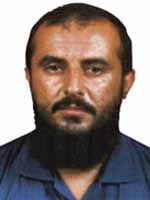
Quso, just before the THE SULLIVANS attack, was actually contacted by bin Attash who told the young operative to meet with one of his men and assist him in transporting money to Southeast Asia [41,42]. Quso agreed and met with bin Attash’s man. The man was Nibras [41,42]. The two traveled to Bangkok where they eventually met with bin Attash and transferred the money over to him [41,42]. Bin Attash was in the midst of participating in the Kuala Lampur summit in Malaysia in which multiple al-Qaida operatives would discuss upcoming ventures. The attendees included two 9/11 hijackers, Khalid al-Mihdhar and Nawaf al-Hazmi [41]. Quso and Nibras returned to Yemen where they were now involved in the upcoming Aden attack. While Nibras would become a bomber, Quso as mentioned, was slated to video the attack. He would receive a page from Badawi, who would send Nibras and Khamri to strike the ship, informing him that it was time to set up the camera in a rented apartment and record [35]. On the day he received the page however, Quso had overslept and was on his way to the apartment when the bomb exploded [35]. Badawi was quickly picked up by the Yemeni security forces at a religious university in Sana’a [35]. Quso was tasked with retrieving and hiding the truck used to tow the boat [28]. In the end, Quso fled Aden for Sana’a but decided to return home and turn himself in after learning that he had family members being detained and harassed by the security forces [35].
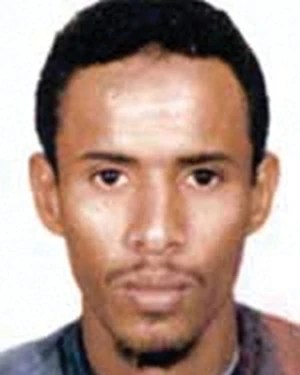
As both Badawi and Quso were apprehended by the Yemenis, they were also interviewed by the FBI after an excessive delay [43]. While many Yemenis were instrumental to the process, some were fairly uncooperative with the FBI in their investigation, keeping suspects from them and blocking extraditions. These Yemenis, including Col. Hussein al-Anzi the PSO leader in Aden, seemed defensive of Quso in particular [44]. They also allegedly allowed Nashiri and his cell safe passage within the country while the attacks were being prepared [45]. Nashiri, by the time of the bombing, had successfully set up a network of Al-Qaida fighters in the Arabian Peninsula, a true precursor to the AQAP of today. The Yemenis would imprison Badawi and Quso and the Americans would have to take that as a pyrrhic victory because there was apparently no chance that they would have an opportunity to try the two men in the US [46].
In the next Chapter we will delve into some of the other personalities in the Yemeni al-Qaida Nexus, as well as plots coordinated by Nashiri and his accomplices in the aftermath of 9/11.
CITATIONS:
- [1] US Kills Al-Qaida suspects in Yemen, The Associated Press, November 5, 2002, http://usatoday30.usatoday.com/news/world/2002-11-04-yemen-explosion_x.htm
- [2] THREATS AND RESPONSES: HUNT FOR SUSPECTS; Fatal Strike in Yemen Was Based on Rules Set Out by Bush, by David Johnston and David E. Sanger, The New York Times, November 6, 2002, http://www.nytimes.com/2002/11/06/world/threats-responses-hunt-for-suspects-fatal-strike-yemen-was-based-rules-set-bush.html?pagewanted=all&src=pm
- [3] Yemen Admits Cooperating with US in Missile Attack, Middle East Online, November 20, 2002, http://www.middle-east-online.com/english/?id=3328
- [4] Yemen Captures Al-Qaida Members, BBC News, March 4, 2004, http://news.bbc.co.uk/2/hi/middle_east/3531657.stm
- [5] US confirms death of man linked to alleged Buffalo terror cell, CNN News, November 12, 2002, http://articles.cnn.com/2002-11-12/us/yemen.blast.us_1_ahmed-hijazi-kamal-derwish-men-of-yemeni-descent?_s=PM:US
- [6] Paul Wolfowitz Interview with Maria Ressa of CNN International, US Department of Defense: Office of the Assistant Secretary of Defense, November 5, 2002, http://www.defense.gov/transcripts/transcript.aspx?transcriptid=3264
- [7] The Trail of Evidence – Hunting Bin Laden, PBS Frontline, The FBI Executive Summary of Evidence in Embassy Bombings, November 18, 1998, http://www.pbs.org/wgbh/pages/frontline/shows/binladen/bombings/summary.html
- [8] Abdulrahim al-Nashiri Charge Sheet, September 15, 2011, https://www.mc.mil/Portals/0/pdfs/alNashiri2/Al%20Nashiri%20II%20(Referred%20Charges).pdf
- [9] Abdulrahim al-Nashiri Guantanamo Assessment File, ISN 10015, http://wikileaks.org/gitmo/prisoner/10015.html
- [10] 9/11 Commission Report, p. 152
- [11] The Black Banners: The Inside Story of 911 and the War Against Al-Qaeda, Ali Soufan, W.W. Norton and Company, 2011, p. 208
- [12] The Black Banners, Ali Soufan, p. 272-274
- [13] The Black Banners, Ali Soufan, p. 95-97
- [14] The Black Banners, Ali Soufan p. 111-112
- [15] The Black Banners, Ali Soufan, p. 185
- [16] 9/11 Commission Report, p. 191
- [17] The Black Banners, Ali Soufan, p. 84-87
- [18] Pentagon Sets Sights on Taliban’s Elite Brigade 55, Afghanistan News Center, October 15, 2001 http://www.afghanistannewscenter.com/news/2001/october/oct15x2001.html
- [19] The Black Banners, Ali Soufan, p. 269-272
- [20] Walid Mohamed Saleh bin Attash Guantanamo Assessment File, ISN 10014, http://wikileaks.org/gitmo/prisoner/10014.html
- [21] Obituary of Mohamed Atef, The Guardian, November 18, 2001, http://www.guardian.co.uk/news/2001/nov/19/guardianobituaries.afghanistan
- [22] Man arrested at Cairo Airport not Al-Qaida Commander, BBC News, February 29, 2012, http://www.bbc.co.uk/news/world-middle-east-17204128
- [23] The Secret Sentry: The Untold Story of the National Security Agency, Matthew Aid, p. 209-211
- [24] The Black Banners, Ali Soufan, p. 279
- [25] The Black Banners, Ali Soufan, p. 273-274
- [26] The Black Banners, Ali Soufan, p. 275-276
- [27] The Black Banners, Ali Soufan, p. 241
- [28] Abdulrahim al-Nashiri Charge Sheet, June 30, 2008, https://www.mc.mil/Portals/0/pdfs/alNashiri/Al%20Nashiri%20(AE001)%20Sworn%20Charge%20Sheet.pdf
- [29] The Black Banners, Ali Soufan, p. 276-277
- [30] 9/11 Commission Report
- [31] The Black Banners, Ali Soufan, p. 277-279
- [32] 9/11 Commission Report, p. 156
- [33] The Black Banners, Ali Soufan, p. 270
- [34] The Black Banners, Ali Soufan, p. 342
- [35] The Black Banners, Ali Soufan, p. 246-248
- [36] The Black Banners, Ali Soufan, p. 344-346
- [37] Jihad in Saudi Arabia: Violence and Pan-Islamism Since 1979, Thomas Hegghammer
- [38] Salim Ahmed Hamdan “Saqar al-Jedawi” Interrogation PDF
- [39] Al-Quds interview with Abu Jandal, Al-Quds Al-Arabi headline: “Abu-Jandal, Former Personal Bodyguard of Usama Bin Ladin and Leading Al-Qa’ida Element in Yemen Reveals to Al-Quds Al-Arabi his Intercession in Bin Ladin’s Marriage to a Yemeni Girl. He Used to Meet With Al-Zarqawi, but Says he is not a Leader. The United States Moves Toward its Demise. Saudi Bombings Are the Natural Outcome of the Regim’s Policy and They Will Continue” , Al-Quds al-Arabi News, August 3, 2004, http://cryptome.org/alqaeda-plans.htm
- [40] The Black Banners, Ali Soufan, p. 329-334
- [41] 9/11 Commission Report, p. 159
- [42] The Black Banners, Ali Soufan, p. 253-254
- [43] The Black Banners, Ali Soufan, p. 236
- [44] The Black Banners, Ali Soufan, p. 250
- [45] Yemen gov’t aided Gitmo detainee al Nashiri before the USS Cole attack, sheltered him after, by Jane Novak, Armies of Liberation, November 4, 2011, http://armiesofliberation.com/archives/2011/11/04/yemen-govt-aided-gimto-detainee-al-nashiri-before-the-uss-cole-attack-sheltered-him-after/
- [46] Probe of the USS Cole unravels, by Craig Whitlock, The Washington Post, May 4, 2008, http://www.washingtonpost.com/wp-dyn/content/article/2008/05/03/AR2008050302047.html
© Copyright 2024 Nolan R Beasley
 Chronicles in Zealotry