
During the month between the announcement and the official implementation of the terrorist designation against the Houthis, the Iranian proxies only increased their attacks and threats. In this Chapter we discuss these events, plus examine additional Houthi personnel of interest and their weaponry of choice.
HOUTHI SANCTIONS
Offering gratitude to God, Abdulmalik al-Houthi reveled in the opportunity to engage the Americans and Israelis in a form of obstinate belligerence, masquerading as political protest [1]. A televised address from the Houthi patriarch encouraged his followers to stand with the persistent attacks, as in his opinion, the Houthis emerged from conflict strengthened and reinvigorated [1]. Houthi reassured his people that the airstrikes of Poseidon Archer were doing little to degrade the military capacity of the militants, and that he had no intention of capitulating to American demands [1]. This refuted the American assessment of dismantling an approximate 25 percent of Houthi projectile launching abilities [1]. Although with a mobile force of missile and drone launchers, the assessment was but a generous estimate. Houthi laughed away the new terrorist designation upon his movement, labeling the militants as victims of American oppressors instead [1]. Houthi was not going to be deterred by designations or limited bombings raids. He stood to gain a potentially positive international profile of standing against superior American firepower while maintaining solidarity with the Palestinian cause. Yet he also risked further alienating his movement from any potential support by risking the fragile peace in war devastated Yemen, among the starving, ill, and exhausted population. Perhaps more importantly, by placing international commerce at risk of and in some cases already subject to increased prices, he stood to be targeted for repercussions, knowing that many nations would only respond due to the financial consequences of Houthi aggression. Undoubtedly intent to make himself a champion to the disillusioned and oppressed, he was attempting to resist American political might and pursue action against the world economic powers reviled in a catastrophic humanitarian situation such as in Yemen.
For the third day in succession, on January 18, the Americans and Houthis traded fire. At 1540 in the afternoon, US forces identified and eliminated two Houthi anti-ship missiles preparing to launch into the Red Sea, as a part of Poseidon Archer [2]. In response, at 2100 the Houthis launched two additional anti-ship ballistic missiles, aimed at the Marshall Islands-flagged, American owned, Greek operated tanker MV Chem Ranger [3]. The missiles impacted in the Gulf of Aden near the vessel but resulted in no damages [3,4]. Traveling from Jeddah, Saudi Arabia to Kuwait, the smaller tanker was reported by the militants to be directly impacted, but this was yet another exaggeration on the part of the Houthi propaganda machine [5].
With the Houthis slated for redesignation as a terrorist entity by the US State Department, individual militants also faced further sanctions. The US Treasury followed the State Department’s example and soon after on January 25, sanctioned four Houthi officers directly responsible for the commercial shipping attack campaign [6]. This included the Houthi Minister of Defense Mohamed al-Atifi, known to have sworn to transform the Red Sea theatre into a “graveyard” in response to the international coalition operations against his militants [6]. Atifi was a Saleh era Major General, who upon the fall of Sanaa to the Houthis, chose to join the militants and be indoctrinated into their influence [7]. Of note, he was a former head of the “Missiles Brigade Group,” and was known to facilitate the aerospace forces of the Houthis, comprising the many drone and missile options at their disposal [7]. Also designated by the Treasury was Mohamed Fadhil Abd al-Nabi, the chief of Houthi naval forces [6]. Having visited the hijacked MV Galaxy Leader in port Hudaidah, he displayed that the piracy operations in the Red Sea were under his control [6]. The Coastal Defense Forces director Mohamed Ali al-Qadiri, also operated the Naval College for the militants, and was specifically ordered to conduct the series of shipping attacks on behalf of his superiors [6]. Lastly, Mohamed Ahmed al-Talibi coordinated with a vast array of smuggling networks in order to bring Iranian weapons and weapon components into Yemen [6]. Colloquially known as the Director of Procurement, he received orders from senior Houthi leadership, and was responsible for obtaining a wealth of illegal weapons, drones, and vital systems parts for usage by the belligerents [6]. These four did not represent the total of those responsible for the attacks, but it was a small step forward in holding the militants responsible.
HOUTHI ARSENAL: EXAMPLES OF DRONES AND MISSILES
As to what exactly these weapons and capabilities possessed by the Houthis were, exhaustive research by news outlets such as Reuters proved that the militants readily utilized and displayed a variety of Iranian projectiles [8]. Frighteningly, these included the Iranian produced Tufan (Arabic for deluge) surface to surface cruise missile, with a range of up to 1200 miles, and intended for Israel [8]. Another was the Aqil, which was itself a variant of the Iranian produced Qiam ballistic missile, with a range of 600 miles [9]. Another medium range ballistic missile, at an approximate 600 mile range, was a variant of the Iranian Zolfaghar missile [9]. For strikes against Eilat, the Houthis would need to employ the Tufan or a weapon with similar range [9]. According to Forbes, the November 8 downing of a ballistic missile over the Red Sea by an IDF Arrow 3 interceptor was an operation against an inbound threat to Eilat, and occurred nearly 60 miles above the sea, giving credence to the idea that the threat was in fact a Tufan [9]. There was also the fear presented, that Iran could have provided the Houthis with its new Paveh cruise missiles, with a range of above 1000 miles [9]. As for the array of anti-ship missiles at the disposal of the Houthis, there were several each in the subcategories of ballistic and cruise missiles. The Mohit, Asef, Tankil, Falaq, al-Bahr al-Ahmar, and Mayun ballistic missiles were provided for by Iran or assimilated during the 2014 conquering [8]. All are guided by infrared or electro-optical means [8]. Tankil was of particular concern, known to reach distances of 300 nautical miles into the sea [8]. The Falaq was known as the first guided missile possessed by the Houthis [9]. Cruise missiles provided for by Iran or assimilated from the prior regime, included the Rubezh, al-Mandeb 1, al-Mandeb 2, Sayyad, Quds Z-0, and Sejil [8]. These missiles are all guided via radar homing with the exception of the Quds Z-0, which utilizes infrared and electro-optical abilities [8]. The Quds Z-0 could strike at sea or on land, and along with several other missile varieties (including the Tufan) were paraded through Sanaa in September 2023 as a display of strength [8,9]. An early November downing of a cruise missile via an IDF F-35 displayed visual evidence of the projectile perhaps being a Quds Z-0 [9].
Drones were also assimilated into the militant forces, and/or provided by the Iranians [8]. The Rased and Hudhud-1 varieties were small and possessed rather insignificant range capabilities [8]. Cost effective and lethal attack drones, produced by Iran, greatly increased the Houthi range. These included the Qasef 1 and 2 variants at up to 60 nautical miles and the Sammad 1 and 2 variants, which expanded the range to upwards of 300 nautical miles at the expense of smaller explosive warheads [8]. The American designator for a Sammad drone was a KAS-04, and this variant was known to have been engaged by the USS CARNEY back on November 29 [8]. However, the most utilized and efficient Iranian drone employed by the Houthis against shipping was the Shahid-136, known for its loitering capability, greatly expanded range, and lethal explosive warhead [8]. The Shahid-136 also possesses the option for improved navigation and targeting, with the potential ability to adjust settings midflight [8]. The drone is launched from a mobile platform (usually a truck or other vehicle) at an angle, and then propels itself out to its destination [8]. Thus, the locating and eradication of the drones and their launchers is of significant difficulty. Further, while in flight the triangular shape of the drone combined with its decreased altitude flight path reduce the chances for radar detection, allowing the Shahid to close its target, despite the limitations of a slow overall velocity [8]. Some sort of additional guidance capability must be present with the drones, given their targets are moving on the open sea, thus stationary target inputs would be unfeasible [8]. Other actors besides Iran may also have been responsible for arming the Houthis, as North Korea was portrayed by the UN as recently as 2019 as attempting to sell weapons to the Yemeni militants, comprising of ballistic missile technology, despite a strict arms embargo [10]. Yet the Iranians were the most direct participants in providing the Houthis the needed support for maintaining and expanding a violent campaign.
For example, observers and experts in maritime commerce hypothesized that the expanding of attacks into the Gulf of Aden was possibly linked to the Iranian intelligence gathering ship in the region, MV Behshad, mimicking a cargo vessel traversing the waters [11]. As most of the traffic followed lanes from the Gulf of Aden through the Bab al-Mandeb strait and onward through the Red Sea, or vice versa, it was observed as an oddity that MV Behshad apparently patrolled specific zones or boxes in the Arabian Sea [11]. Intelligence assessments accused the Behshad of providing targeting data and intelligence on other commercial vessels to the Houthis as well as acting as a platform for their maritime forces [11]. The latter was observed via numerous small attack craft coming to and from the Behshad [11]. The Behshad, first affiliated with Iranian businesses in 1999, was not believed converted into an IRGC and Houthi asset until 2021, when it sailed into the Red Sea to replace the previous version of the platform, the MV Saviz [11]. Interestingly, Saviz was removed from the region by a suspected Israeli limpet mine in April 2021, after the Iranians attacked an Israeli flagged merchant vessel in the Indian Ocean via missile [12]. This represented a separate spate of shipping attacks between Israel and Iran from the years prior and was less of an international concern than the current iteration [12]. Now the conflict directly involved American and European powers.
During the aforementioned Sanaa military parade on September 21, 2023, Yahya Saree proudly proclaimed the advancements inherent in the new missile systems of Aqil, Tankil, Quds, and Tufan [13]. While the intent was meant to be threatening and sinister, there were underlying nuances to the saga, one acting as a precursor to the impending Red Sea conflict, while the other was strategy relating to cost and expenditures. Analysts began to lament early in the confrontation on the disparity between the costs of Houthi drones and weaponry, when compared to that of American munitions utilized to neutralize the threats [14]. For example, the SM-2 (Standard Missile) fired in defense by US destroyers and cruisers, boasted a price of $2.1 million each, meaning that the expense to down the myriad relatively inexpensive Houthis projectiles and drones was enormous [14]. Suggestions that the destroyers rely on other methods to eliminate the drones or missiles were dismissed, as it meant that the projectile would by default have to be unfeasibly close to the war vessels first, increasing unnecessary risk [14]. Simply put, the Houthis could theoretically create a situation where they exhausted the American willingness to continue to spend such sums against relatively simple targets. All of the projectiles were dangerous, but slow-paced drones were being destroyed by far superior weaponry. US Naval officers provided a different perspective, stating that the conflict proved that American naval missile defenses were functional and capable, being battle tested and succeeding [15]. The sheer battle experience gained by the Navy, along with the knowledge that systems were efficiently employed, was invaluable [15]. Missiles represented a different issue and offered some reasoning for the Houthis rapid employment of the systems after October 7: revenge and vindication. This was because the cost for the Houthis in testing and ensuring these systems’ functionality had also been immense. Sanctioned by the Americans in 2021, Ahmed Ali al-Hamzi was the Houthi general helming their Air Force and Air Defense [16]. The militants acknowledged his death on August 6, 2023, but were coy in the reasoning, offering an excuse of his demise to “illness [16].” The reality entailed a much more interesting story. Hamzi along with Air Defense Maj. General Mohamed Hussain Saleh al-Hamasi were present at a missile testing site in Serwah, Marib province, Yemen, joined by experts from Iran and Lebanese Hezbollah [17]. During the testing, something when horrendously awry, and the site suffered a chain of immense explosions lasting for two days as secondary blasts decimated weapons stores [17]. The chaos resulted in the killing of the two generals and their consultants from Iran and Lebanon, as well as the wounding of several others [17]. The Houthis were attempting to gain advantage during the tenuous peace with the Saudis, replenishing their weapons cache with new missiles, as overseen and provided for by Iran [17]. The cause of the explosions remained enigmatic and unconfirmed. Thus, the Houthis, if they were the victims of sabotage maintained an appetite for revenge and displays of strength within the region, and if they were the victims of their own incompetence and mishandling of the missiles, then they were eager to be vindicated by demonstrating that the missiles were effective, worthwhile, and successful in actual warfare usage.
SECOND MAJOR OFFENSIVE STRIKES OF POSEIDON ARCHER
Prowling for these missiles before they could be employed were the fighter jets of the DWIGHT D EISENHOWER Strike Group. Deciding that targets presented a critical threat to commercial shipping, the Americans conducted airstrikes at 1845 on January 19, destroying three anti-ship missiles aimed towards the Red Sea and ready to fire [18]. A following preemptive strike occurred at 0400 the next morning, targeting and demolishing another anti-ship missile, this one aimed into the Gulf of Aden [19]. While these events represented airstrikes against targets of opportunity, additional significant rounds of airstrikes were planned.
Another robust series of airstrikes occurred on January 22, right before midnight and the arrival of January 23 [20]. In conjunction with direct support from the British military, Americans conducted this portion of Poseidon Archer with support from Australia, Canada, the Netherlands, and Bahrain [20]. Targets at eight different locations within Houthi territory were attacked [20]. These strikes were intended to reduce the capabilities and supplies of the Houthis, in order to preclude them from increasing their Red Sea attacks in the future [21]. As such, weapons caches and underground storage bunkers housing Houthi missiles and drones were targeted [20]. Again, air defense systems and Houthi radar installations were destroyed, along with missile systems and their launchers in this round of strikes [20]. Up to 40 guided munitions were utilized [21]. One weapons storage facility was described as deep underground [20] and held the most advanced Houthi weaponry destroyed thus far during Poseidon Archer [22]. Destruction of this type of facility was instrumental in the overall goal of implementing resource depletion against the Houthis [21]. The reliable F/A-18s of the EISENHOWER along with British Typhoon fighters were dispatched for the mission [21]. Tomahawk Land Attack Missiles were again fired from submarine and surface ship platforms [22]. USS FLORIDA SSGN 728 remained as the only guided missile submarine in the theater. The British Typhoons again numbered four, as they did in the first mission of Poseidon Archer, and were again joined by two Voyager tanker aircraft, for mid-flight refueling [23]. The Typhoons utilized their Paveway IV munitions against two of the targets located near the Sanaa airfield [23]. At least 25 of the Houthi missile launch installations targeted by the combined force were damaged or eliminated [23]. The New York Times reported that estimates held that the Houthis were reduced in their offensive capabilities by 20 to 30 percent following the January 11 strikes, and that after the January 22, they have been reduced by 30 to 40 percent [21]. This however must be accepted skeptically as US officials admitted to a lack of knowledge in exactly how many projectiles the Houthis began the conflict possessing [21]. Yahya Saree swore to the predictable revenge of the Houthis, promising a response [21]. As it turned out, part of the Houthi retribution was imaginary, as they claimed to have launched a missile attack on the American cargo vessel MV Ocean Jazz traversing the Gulf of Aden [24]. This was due to the ship’s association with the US military [21]. However, American officials categorically denied that this event ever happened, and vouched for the safe transit of the Ocean Jazz [24].
Typical self-defense strikes resumed as at 0230 on January 24, American airstrikes destroyed two anti-ship missiles aimed at the Red Sea before they could successfully launch [25]. The Houthis retained enough in their arsenal to repeatedly fire missiles into the shipping lanes. At 1400 the same day, three different Houthi anti-ship ballistic missiles were fired against a convoy in the Gulf of Aden escorted by USS GRAVELY DDG-107 [26]. The convoy was comprised of American-flagged cargo vessels, the MV Maersk Detroit and MV Maersk Chesapeake, which were both contracted to carry freight for various US agencies, most prominently, the US Department of Defense and US Department of State [27]. Undoubtedly, they held military equipment onboard, and were thus prized targets for the Houthis. One of the projectiles impacted the sea on its own accord, proving inconsequential to the convoy [26]. GRAVELY dispatched the remaining two missiles, downing them before they could reach their prey [26]. However, the vessels did not proceed through the Bab al-Mandeb but retreated into the Gulf of Aden under US Naval escort [27]. Maersk confirmed the incident and again responded by suspending traffic through the strait and Red Sea [27]. QatarEnergy insinuated that it would traverse around the Cape of Good Hope and avoid the Red Sea, despite no Qatari vessels having been targeted thus far [27]. The same day saw another vessel, the Liberian-flagged bulk carrier MV Tomahawk also harassed by a drone which exploded in vicinity of the ship [8,28].
CONTINUED HOUTHI AGGRESSION, A US DESTROYER’S CLOSE ENCOUNTER, AND MORE WEAPONS INTERDICTION:
The semantics of warfare were displayed on January 26, when the American military admitted that the Houthis fired a missile directed towards the USS CARNEY, a projectile which the destroyer easily dispatched [29]. The attack, at time 1330, occurred as CARNEY patrolled the Gulf of Aden [29]. The admission was observed as the US acquiescing to the fact that the Houthis were willingly targeted US forces in the region, much like their kin were doing in Iraq and Syria [30]. Assuredly, this was not the first time that a missile was fired at a US naval asset in the conflict, as has been documented in this series, but the acknowledgement from US officials meant that the potential for further escalation was apparent [30]. Further it matched with the Houthi promise to focus on US and UK ships of all sorts as their retribution for the series of airstrikes against them.
Later in the day on January 26, at 1945, the Houthis succeeded in striking a commercial freighter, as an anti-ship ballistic missile impacted the Marshall Islands-flagged oil tanker MV Marlin Luanda [31]. Upon receiving a distress call, CARNEY hurried back into the fray [31]. Russian produced naphtha stored in the vessel ignited, causing a significant fire onboard, and overwhelming the firefighting capabilities of the crew of 22 Indians and one Bangladeshi [32]. None of the crew were injured during the debacle but required assistance from foreign navies to intervene in the firefighting efforts [32]. A team of 10 from the Indian Navy responded to assist with the fire [32]. In fact, the CARNEY, the Indian INS VISAKHAPATNAM DD-66, and the French frigate FS ALSACE D656, all arrived rapidly to the scene in the Gulf of Aden and ensured that the raging fire was eventually extinguished [33]. Singapore based company Trafigura claimed that once the fire was controlled, the vessel continued on its intended path despite the attack [32]. The Houthis claimed to have attacked a British tanker [34]. The vessel was flagged in the Marshall Islands, owned by a Bermuda entity, and operated by the Singaporean firm Trafigura, which itself has offices in Britain [33,34]. However, British authorities declared that they retained the right to respond appropriately to the attack or any others on commercial shipping [34]. Other traffic was affected by the incident, as reports came in of at least one tanker fleeing from the strait to avoid any potential attacks [34].
Both the British and Americans responded in varying ways after the frantic prior day. For the Americans, the response was offensive, wherein at 0345 on January 27, an airstrike was conducted against another Houthi anti-ship missile, destroying it before it could be fired into the Red Sea [35]. For the British, their action was defensive, as the destroyer HMS Diamond successfully downed an incoming drone in the Red Sea, believed to be targeting the warship [36].
The defensive actions of the British were also demonstrated by their neighbors in the European Union. By the end of January, EU leaders announced that they would deliver war ships to the volatile region in order to protect commercial shipping in a strictly defensive EU mission, separate than the ongoing Prosperity Guardian [37]. At the time, the EU was waiting to decide which nations would provide military assets and which would helm the mission, noting that a decision was to be made at their next Foreign Affairs Council gathering on February 19 [37]. Nonetheless, the mission’s moniker was leaked as “Aspides,” which as Greek for shield, only helped to propel rumors that it was to be the Greeks in charge [37].
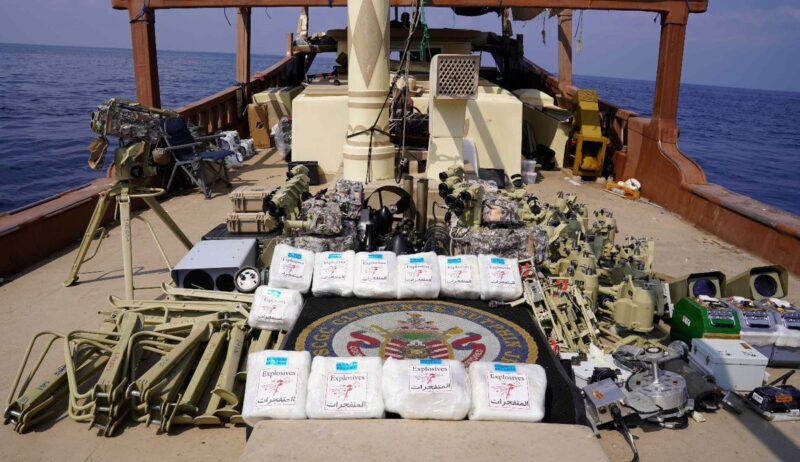
The European mission would not only offer defense of cargo vessels, but another vital partner in interdiction, and the prevention of Iranian weaponry reaching the Houthis. As it was, these illegal shipments were still being deployed to the Houthis via smuggling routes and among illicit cargo of various carriers. As such, on January 28, the US Coast Guard Cutter Clarence Sutphin WCP-1147, sailing under the NAVCENT component of USCENTCOM, intercepted one such vessel, boarded it, and confiscated immense amounts of illegal components destined for the Houthis [38]. Among 200 separate packages captured in the Arabian Sea mission, were various components for ballistic missiles, anti-tank guided weaponry, and other explosives [38]. Advanced communication devices and systems were discovered, along with further components for the rising threat of unmanned underwater vehicles and unmanned surface vehicles [38]. The interdiction was a success but left open the question of how many of these shipments were successfully reaching the Houthis in order to increase their technological acumen during the fight. In fact, the Iranian frigate ALBORZ arrived in the Red Sea on January 1, just after the first fatal interaction between the Americans and Houthis [39]. Observers opined that the frigate was possibly in the region to complicate American and European responses, or to protect these smuggling vessels en route to the Houthis [39].

The Americans remained on the offensive, as their conflict with Iranian proxies dramatically increased upon a fatal drone strike in Jordan on January 28, conducted by the “Islamic Resistance of Iraq,” which killed three Georgia National Guardsmen. For the Americans engaged with the Houthis, January 30 became an unacceptable near tragedy. What was a relatively innocuous CENTCOM press statement by now, revealed that on January 30, 2330, the Houthis launched an anti-ship cruise missile into the Red Sea, which was destroyed by USS GRAVELY on patrol [40]. However, the truth was more startling. The cruise missile was able to approach within one nautical mile of GRAVELY, before the destroyer resorted to its final defense, the Phalanx Close In Weapons System (CIWS) in order to down the projectile [41]. At one mile of distance, at high speed, the missile was within a short timeframe of potentially impacting the warship. The Phalanx CIWS, in simple terms, is an extreme rapid-fire 20 mm cannon, which can shoot at a rate of 4,500 rounds per minute, and is guided by its own built-in radar, in order to destroy close threatening projectiles [42]. Its own rounds are composed of armor piercing tungsten or depleted uranium, heavy metals ensuring the penetration and destruction of enemy incoming missiles. US officials insinuated that perhaps the Iranian provided weaponry utilized by the Houthis now consisted of an improved arsenal [41]. Yet this is not proven. It is unknown how the missile surpassed the initial defenses of GRAVELY, in the form of SM-2 interceptors, or even if those defenses were able to be fired prior to detection of the threat. Regardless, for the GRAVELY to have to employ this device, meant that the Houthis came very close to impacting an American warship.

THE US PREPARES FOR VENGEANCE AGAINST THE IRANIAN PROXIES
American military responses were destined to be severe due to the increased threat, and as the desire to destroy Houthi stockpiles of weapons were hindered by the arrival of smuggled Iranian technology. A threat yet to be realized was neutralized the next day at 1530, when US aircraft destroyed a Houthi surface to air missile as it prepared to launch from Yemen, assumably aimed at fighter jets [43]. Meanwhile, USS CARNEY engaged and destroyed a Houthi anti-ship ballistic missile launched into the Gulf of Aden at 2030 on January 31, followed by the successful downing of three Iranian attack drones at 2110 [44]. As brought up by security analysts, the destroyers were provided with a finite number of interceptor missiles and other capabilities [41]. This furthered the need for additional ships from partners and allies to join the fray, at least in a defensive posture. The closest base where US naval assets could rejuvenate and reload their missiles was in Djibouti, resulting in the ship both being off station and within threat range of Houthi projectiles [45].
As the clock turned to February, the Americans were presented with persistent hostility and more targets of opportunity. At 0130 on February 1, US airstrikes obliterated 10 one-way attack drones, plus a UAV ground control station, deeming them an immediate threat to shipping and naval vessels [46]. The prowling F/A-18s of the EISENHOWER located targets efficiently [47]. Secretary of Defense Lloyd Austin, the same day opined that the Houthis and other proxies were only able to increase attacks with Iranian assistance and warned of the certainty of military responses to the deaths of the three American soldiers in Jordan [47]. Any response would include degradation strikes against the Houthis as well, Austin finding them culpable in the overall regional violence and not just the Red Sea [47]. The Houthis displayed a reckless insistence to carry out the attacks and flaunted their abilities even as the Americans warned of further retaliation. As the morning progressed, the need for these additional and powerful strikes became apparent. By 0500 a drone was downed mid-flight over the Gulf of Aden by US forces, followed by a strike against an unmanned surface vessel approaching Red Sea shipping lanes at 1030 [48]. The day culminated with two anti-ship ballistic missiles impacting the Red Sea in vicinity of the Liberian-flagged and Bermuda owned MV Koi at 1245, fortunately resulting in no damages [48]. The attack again was in the dangerous area off the coast of Hudaidah [46]. Other vessels also reported the proximate explosions of the missiles’ ocean impacts.
February 2 proved just as eventful and forced the hand of the Americans. Beginning at 1030, CARNEY downed a drone flying over the Gulf of Aden, while at 1640, the aircraft of the Strike Group destroyed four additional of the unmanned aerial threats [49]. Finally, at 2120 in the evening, the LABOON combined with F/A-18s from EISENHOWER to down seven drones threatening shipping in the Red Sea [49]. Simultaneously the promised American airstrikes were raining down in Iraq and Syria, exacting vengeance on the IRGC and their proxies in the “Islamic Resistance of Iraq” for the deaths of the Georgian National Guardsmen [50].
We will begin our Fifth chapter with the Biden Administration’s expanded airstrikes against Houthi assets; a portion of the retaliation against Iranian proxy organizations throughout the volatile region.
CITATIONS:
- [1] Houthi Leader Says Clash With U.S. Will Strengthen Militia Group, by Vivian Nereim, The New York Times, January 18, 2024, https://www.nytimes.com/2024/01/18/world/middleeast/houthis-yemen-us.html
- [2] USCENTCOM Destroys Houthi Terrorists’ Anti-Ship Missile, USCENTCOM Press Release, January 18, 2024, https://www.centcom.mil/MEDIA/PRESS-RELEASES/Press-Release-View/Article/3649125/uscentcom-destroys-houthi-terrorists-anti-ship-missiles/
- [3] Third Houthi Terrorists Attack on Commercial Shipping Vessel in Three Days, USCENTCOM Press Release, January 18, 2024, https://www.centcom.mil/MEDIA/PRESS-RELEASES/Press-Release-View/Article/3649828/third-houthi-terrorists-attack-on-commercial-shipping-vessel-in-three-days/
- [4] Maritime Security Off Yemen Coast Threat Update, Operation Atalanta Threat Update, mschoa.org, January 27, 2024, 240127-atalanta-maritime-security-threat-update-red-sea_.pdf (mschoa.org)
- [5] US says Houthis launched missiles at tanker ship but no damage caused, by Kanishka Singh and Costas Pitas, Reuters, January 18, 2024, https://www.reuters.com/world/middle-east/us-says-houthis-launched-missiles-tanker-ship-no-damage-caused-2024-01-19/
- [6] U.S. and UK Target Houthi Military Officials for Supporting Acts of Terrorism, US Department of the Treasury Press Release, January 25, 2024, https://home.treasury.gov/news/press-releases/jy2048
- [7] The Houthi Jihad Council: Command and Control in “the other Hezbollah,” by Michael Knights, Adnan al-Gabarni, and Casey Coombs, CTC Sentinel, October 2022, Vol 15, Issue 10, https://ctc.westpoint.edu/the-houthi-jihad-council-command-and-control-in-the-other-hezbollah/
- [8] Red Sea Attacks, by Simon Scarr, Adolfo Arranz, Jonathan Saul, Han Huang, and Jitesh Chowdhury, Reuters, February 2, 2024, https://www.reuters.com/graphics/ISRAEL-PALESTINIANS/SHIPPING-ARMS/lgvdnngeyvo/
- [9] What Are the Missiles the Houthis Have Fired at Israel?, by Eric Tegler, Forbes, November 10, 2023, https://www.forbes.com/sites/erictegler/2023/11/10/what-are-the-missiles-the-houthis-have-fired-at-israel/?sh=27945be93c07
- [10] UN Experts: North Korea Seeking to Arm Houthis, by Ali Barada, Asharq al-Awsat, February 7, 2019, https://english.aawsat.com/home/article/1580161/un-experts-north-korea-seeking-arm-houthis
- [11] Spotlight On Iran’s “Spy Ship” Behshad, MariTimes Crimes, February 8, 2024, https://maritimescrimes.com/2024/02/08/spotlight-on-irans-spy-ship-behshad/
- [12] Analysis: Saviz attack a significant shift in “war of the ships” between Israel and Iran, by Ahmed Eleiba, Ahram Online, April 9, 2021, https://english.ahram.org.eg/News/408791.aspx
- [13] How the Houthis Built Their Arsenal: Defense and Intelligence Procurement, Counter Extremism Project, November 2023, https://www.counterextremism.com/content/how-houthis-built-their-arsenal-defense-and-intelligence-procurement
- [14] A $2M missile vs. a $2,000 drone: Pentagon worried over cost of Houthi attacks, by Lara Seligman and Matt Berg, Politico, December 19, 2023, https://www.politico.com/news/2023/12/19/missile-drone-pentagon-houthi-attacks-iran-00132480
- [15] US warships are shooting down weapons no one’s ever faced in combat before, and a Navy commander says it’s a ‘great opportunity’, by Jake Epstein, February 17, 2024, Business Insider, https://www.businessinsider.com/us-navy-learning-battles-houthi-anti-ship-ballistic-missiles-commanders-2024-2
- [16] US, UN-sanctioned Houthi Air Force and Air Defense Force commander dies, by Saeed al-Batati, Arab News, August 6, 2023, https://www.arabnews.com/node/2350571/middle-east
- [17] Houthis confirm death of second military leader in a week, by Saeed al-Batati, Arab News, August 10, 2023, https://www.arabnews.com/node/2351806/middle-east
- [18] USCENTCOM Destroys Three Houthi Terrorists’ Anti-Ship Missiles, USCENTCOM Press Release, January 19, 2024, https://www.centcom.mil/MEDIA/PRESS-RELEASES/Press-Release-View/Article/3651182/uscentcom-destroys-three-houthi-terrorists-anti-ship-missiles/
- [19] U.S. CENTCOM Destroys Houthi Terrorists’ Anti-Ship Missile, USCENTCOM Press Release, January 20, 2024, https://www.centcom.mil/MEDIA/PRESS-RELEASES/Press-Release-View/Article/3651207/us-centcom-destroys-houthi-terrorists-anti-ship-missile/
- [20] U.S. Forces, Allies Conduct Joint Strikes in Yemen, USCENTCOM Press Release, January 23, 2024, https://www.centcom.mil/MEDIA/PRESS-RELEASES/Press-Release-View/Article/3652569/us-forces-allies-conduct-joint-strikes-in-yemen/
- [21] U.S. Expands Attacks on Houthis With New Strikes in Yemen, by Eric Schmitt, The New York Times, January 22, 2024, https://www.nytimes.com/2024/01/22/us/politics/houthi-yemen-strikes.html
- [22] American, British forces carry out large-scale strikes on Houthis in Yemen, by Lara Seligman and Alexander Ward, Politico, January 22, 2024, https://www.politico.com/news/2024/01/22/houthi-yemen-strike-us-uk-red-sea-00137056
- [23] US and UK launch fresh strikes on Houthis in Yemen, by Ruth Comerford and Frank Gardner, BBC News, January 23, 2024, https://www.bbc.com/news/world-middle-east-68064422
- [24] US denies Yemen’s Houthis claim of attack on US military cargo ship in Gulf of Aden, by Hatem Maher and Ahmed Tolba, Reuters, January 22, 2024, https://www.reuters.com/world/middle-east/yemens-houthis-say-they-attacked-american-military-cargo-ship-gulf-aden-2024-01-22/
- [25] U.S. CENTCOM Destroys Two Houthi Terrorists’ Anti-Ship Missile, USCENTCOM Press Release, January 23, 2024, https://www.centcom.mil/MEDIA/PRESS-RELEASES/Press-Release-View/Article/3654050/us-centcom-destroys-two-houthi-terrorists-anti-ship-missile/
- [26] Houthis Attack Commercial Shipping Vessel with Anti-Ship Missiles, USCENTCOM Press Release, January 24, 2024, https://www.centcom.mil/MEDIA/PRESS-RELEASES/Press-Release-View/Article/3654573/houthis-attack-commercial-shipping-vessel-with-anti-ship-missiles/
- [27] 2 US-Flagged Ships with Cargo for US Defense Department Come Under Attack by Yemen’s Houthi Rebels, by Jon Gambrell, Military.com, January 24, 2024, https://www.military.com/daily-news/2024/01/24/2-us-flagged-ships-cargo-us-defense-department-come-under-attack-yemens-houthi-rebels.html
- [28] AMBREY, Threat Circular for Indian Ocean Region, January 29, 2024, https://storymaps.arcgis.com/stories/421fb32ec0be48e088ce3da76e38ee9d?play=true&speed=slow
- [29] Houthis Fire Anti-Ship Ballistic Missile Toward USS Carney (DDG 64), USCENTCOM Press Release, January 26, 2024, https://www.centcom.mil/MEDIA/PRESS-RELEASES/Press-Release-View/Article/3657266/houthis-fire-anti-ship-ballistic-missile-toward-uss-carney-ddg-64/
- [30] USS Carney shoots down missile in first attack on Navy since October, by Jon Gambrell and Tara Copp, Navy Times, January 26, 2024, https://www.navytimes.com/news/your-navy/2024/01/26/uss-carney-shoots-down-missile-in-first-attack-on-navy-since-october/
- [31] Houthis Strike M/V Marlin Luanda Operating in the Gulf of Aden, USCENTCOM Press Release, January 27, 2024, https://www.centcom.mil/MEDIA/PRESS-RELEASES/Press-Release-View/Article/3658422/houthis-strike-mv-marlin-luanda-operating-in-the-gulf-of-aden/
- [32] US, French, Indian navies helped put out fire on tanker hit by Houthis — Pentagon, by Times of Israel Staff, The Times of Israel, January 28, 2024, https://www.timesofisrael.com/liveblog_entry/us-french-indian-navies-helped-put-out-fire-on-tanker-hit-by-houthis-pentagon/
- [33] UPDATE: Fire Extinguished on M/V Marlin Luanda Following Houthi Anti-Ship Ballistic Missile Attack, USCENTCOM Press Release, January 27, 2024, https://www.centcom.mil/MEDIA/PRESS-RELEASES/Press-Release-View/Article/3658448/update-fire-extinguished-on-mv-marlin-luanda-following-houthi-anti-ship-ballist/
- [34] UK ‘reserves right to respond’ after oil tanker set alight off Yemen, by Amy Sedghi and Tom Ambrose, The Guardian, January 27, 2024, https://amp.theguardian.com/world/2024/jan/26/vessel-on-fire-after-being-struck-off-coast-of-yemen-amid-houthi-threats
- [35] U.S. Conducts Self-Defense Strike Against Houthi Anti-Ship Missile, USCENTCOM Press Release, January 27, 2024, https://www.centcom.mil/MEDIA/PRESS-RELEASES/Press-Release-View/Article/3658425/us-conducts-self-defense-strike-against-houthi-anti-ship-missile/
- [36] Red Sea: UK navy ship HMS Diamond shoots down Houthi drone, BBC News, January 28, 2024, https://www.bbc.com/news/world-middle-east-68122944
- [37] EU’s Red Sea mission set to launch in mid-February, officials confirm, by Laura Kayali, Politico, January 31, 2024, https://www.politico.eu/article/eus-red-sea-mission-could-launch-february-17/
- [38] CENTCOM Intercepts Iranian Weapons Shipment Intended for Houthis, USCENTCOM Press Release, February 15, 2024, https://www.centcom.mil/MEDIA/PRESS-RELEASES/Press-Release-View/Article/3677794/centcom-intercepts-iranian-weapons-shipment-intended-for-houthis/
- [39] Red Sea Shipping Takes Another Blow From Iran, by Elisabeth Braw, Foreign Policy, January 8, 2024, https://foreignpolicy.com/2024/01/08/houthi-red-sea-attacks-iran-shipping-operation-prosperity-guardian/
- [40] Houthis fire anti-ship cruise missile toward Red Sea, USCENTCOM Press Release, January 30, 2024, https://www.centcom.mil/MEDIA/PRESS-RELEASES/Press-Release-View/Article/3661354/houthis-fire-anti-ship-cruise-missile-toward-red-sea/
- [41] US warship had close call with Houthi missile in Red Sea, by Oren Liebermann and Natasha Bertrand, CNN, February 1, 2024, https://www.cnn.com/2024/01/31/politics/us-warship-close-call-houthi-missile/index.html
- [42] A Houthi missile got so close to a US destroyer the warship turned to a last-resort gun system to shoot it down: report, by Ella Sherman and Jake Epstein, Business Insider, January 31, 2024, https://www.businessinsider.com/houthi-missile-close-us-warship-close-in-weapon-system-2024-1
- [43] U.S. Forces Strike and Destroy Houthi Surface-to-Air Missile, USCENTCOM Press Release, January 31, 2024, https://www.centcom.mil/MEDIA/PRESS-RELEASES/Press-Release-View/Article/3662185/us-forces-strike-and-destroy-houthi-surface-to-air-missile/
- [44] Houthi Anti-Ship Ballistic Missile and Iranian UAVs Shot Down in Gulf of Aden, USCENTCOM Press Release, January 31, 2024, https://www.centcom.mil/MEDIA/PRESS-RELEASES/Press-Release-View/Article/3662725/houthi-anti-ship-ballistic-missile-and-iranian-uavs-shot-down-in-gulf-of-aden/
- [45] How US warships are shooting down Houthi drones in the Red Sea, and what might come next, by Brad Lendon, CNN, December 20, 2023, https://www.cnn.com/2023/12/20/middleeast/us-destroyers-houthi-drones-red-sea-intl-hnk-ml/index.html
- [46] CENTCOM Self-Defense Strike Against Houthi UAVs and Ground Control Station, USCENTCOM Press Release, January 31, 2024, https://www.centcom.mil/MEDIA/PRESS-RELEASES/Press-Release-View/Article/3662708/centcom-self-defense-strike-against-houthi-uavs-and-ground-control-station/
- [47] US hints large response to Iran-backed militias is imminent as Houthi rebels target another ship, by Tara Copp, Lolita C. Baldor, and Jon Gambrell, The Associated Press, February 1, 2024, https://apnews.com/article/yemen-houthi-rebels-ship-attacks-israel-hamas-war-1020fe149d82a32f0160037ea7eef7f5
- [48] CENTCOM Update to Events in the Red Sea, USCENTCOM Press Release, February 1, 2024, https://www.centcom.mil/MEDIA/PRESS-RELEASES/Press-Release-View/Article/3663708/centcom-update-to-events-in-the-red-sea/
- [49] USCENTCOM Red Sea Operational Update, USCENTCOM Press Release, February 2, 2024, https://www.centcom.mil/MEDIA/PRESS-RELEASES/Press-Release-View/Article/3665795/uscentcom-red-sea-operational-update/
- [50] CENTCOM Statement on U.S. Strikes in Iraq and Syria, USCENTCOM Press Release, February 2, 2024, https://www.centcom.mil/MEDIA/PRESS-RELEASES/Press-Release-View/Article/3665602/centcom-statement-on-us-strikes-in-iraq-and-syria/
© Copyright 2024 Nolan R Beasley
 Chronicles in Zealotry