
In the previous installment of this series, we discussed the expanding Houthi threat to international shipping and observed a military coalition response in the initiating of Operation Prosperity Guardian. In this chapter we will explore the ramifications of the increased vigilance and the escalation of the conflict due to continued Houthi aggression
PROSPERITY GUARDIAN AND THE FIRST LETHAL EXCHANGE BETWEEN THE US NAVY AND THE HOUTHIS
Mere days after the implementation of the initiative, Operation Prosperity Guardian was on full display on December 23, as USS LABOON DDG-58, of the DWIGHT D EISENHOWER Strike Group patrolled the southern Red Sea [1,2]. The destroyer was forced to shoot down four drones, reported to be inbound to its position [1,2]. Immediately after the engagement, LABOON responded to distress calls corresponding to additional Houthi attacks [1,2]. The Norwegian-flagged tanker MV Blaamanen was targeted by an attack drone, but fortunately escaped any damage as the Houthi device missed its mark [1,2]. Meanwhile, the Gabonese-flagged tanker MV Saibaba did suffer an impact from a drone, but without major damage or injury to crew [1,2]. Of note, US CENTCOM began to highlight the number of attacks in the region, most likely in an effort to showcase the response of war ships under the auspices of CTF-153 in Prosperity Guardian [2]. As such, according to CENTCOM the Blaamanen and Saibaba represented the 14th and 15th shipping vessels to come under Houthi attack [2]. This numbering is telling, as known and accepted Houthi attacks on shipping thus far numbered at 14, meaning that CENTCOM was probably counting either the supposed Somali pirate hijacking of the MV Ruen, or attempted hijacking of the MV Central Park, in its numbers. It makes the most sense for the count to include MV Central Park and is probably an admission that the vessel was the intended target of the missile launched after its interactions with the pirates. The various other suspicious approaches and threats over radio must not have been counted. Neither were attacks attributed only to the Iranians.
Another anomaly in the sequence of events also occurred on Saturday, December 23. The MV Chem Pluto, a Liberian-flagged, Japanese-owned chemical carrier, transiting from Saudi Arabia to India was well out of bounds for a normal Houthi attack, yet was still impacted by an attack drone while in the Indian Ocean, just 200 nautical miles from India’s northwestern coast [3]. The attack, at time 1000, resulted in some hull damage and included a fire that was eventually contained [3]. Indian naval and coast guard vessels were dispatched for assistance, while the crew fought the fire [4]. The impact also led to a power outage onboard the vessel, rendering it dead in the water, while the crew conducted damage control [4]. No crew was harmed in this incident, seemingly too far away for the Houthis to have committed. American authorities clarified the oddity, accusing Iran directly of launching the attack drone [3]. Previously the IRGC was known to be logistically assisting the Houthis in their Red Sea campaign [3]. Further, the IRGC had threatened to expand the shipping disruption to other parts of the sea, in response to the ongoing Gaza War [3]. In fact, Chem Pluto was believed to have some connections to Israel, giving reason to the Iranian attack [3]. Iran going beyond a support role and taking direct action against international shipping, as well as the US accusation upon them of committing the crime, represented a potentially severe escalation of the conflict [3]. The Houthis were instigating the foundation for a much larger regional war.
This seemed even more apparent on December 26 when the USS DWIGHT D EISENHOWER Strike Group was dragged into the fray yet again. Beginning at time 0630 in the morning, and lasting an exhausting 10 hours, FA-18 Super Hornets launched from the carrier, and escort USS LABOON, engaged and destroyed an astonishing 12 attack drones, three anti-ship ballistic missiles, and two land attack cruise missiles deployed by the Houthis [5,6]. None of the projectiles reached international shipping targets or southern Israel [6]. Yayha Saree televised taking credit for the extended attack, noting that Eilat was once again the target along with a Red Sea cargo vessel [5]. The IDF indicated that it had downed a drone over the Red Sea approaching Eilat, demonstrating that the flood attacks of this nature, allowed for some targets to leak through the defensive perimeter [6]. Fortunately, the Israelis dispatched the threat accordingly, tracking it the entire way before destroying the drone off the coast of the Sinai Peninsula via their air force [7]. Witnesses in the Egyptian settlement of Dahab on the Red Sea heard the destruction and saw the drone fall lifelessly in to the Gulf of Aqaba [7]. As for the vessel, the Houthis indicated that they aimed their assets at the MSC United [7]. While not struck by any projectiles, the MSC United reported that they were indeed targeted, and had reported to the coalition forces of Operation Prosperity Guardian [8]. The ship suffered neither damage nor injuries in the incident and evaded the barrage with the assistance of the Strike Group and its intervention [8].
Maersk meanwhile seemed confident in the measures applied by Operation Prosperity Guardian, and had by December 24, issued a statement expressing their willingness to eventually resume shipping through the Red Sea [6].
Yet the numbers of attacks continued to increase. While MSC United was the only vessel considered targeted on December 26 according to US authorities, it may not have been alone in danger. For example, media sources and EU Maritime Security tracking within the anti-piracy Operation Atalanta reported that the oil tanker Navig8 Montiel was also targeted by a drone that missed the vessel, while in close proximity to the MSC United approximately 50 nautical miles off the coast of Hudaidah, Yemen [9,10]. Nonetheless, the CENTCOM number of attacks tracked jumped dramatically by December 28, when they issued information on the 22nd such event [11]. In this case, an unknown vessel was targeted by a Houthi ballistic missile, which was in turn downed successfully by USS MASON [11]. When the missile was launched there were 18 vessels in the vicinity, protected by the actions of MASON [11]. But with the 14th and 15th reported attacks occurring on December 23, the jump to the 22nd attack by December 28, does not offer much in terms of accounting for the various other instances. The Navig8 Montiel, MSC United, and now December 28 events may be counted as three instances, or perhaps were counted as more due to the nature of the barrage of attacks on December 26. It seems the Chem Pluto attack would not be counted as the attack was attributed to the Iranians as opposed to the Houthis. The December 28 event was counted as just one, assumably because it included but a singular missile. CENTCOM may have been simply updating their numbers, now counting events differently, allowing for the inclusion of the piracy incidents, Iranian attributed attacks, the various circumstances of Naval vessels downing missiles, or other situations previously not immediately connected to the Houthis.
To date the US naval forces in the region had yet to engage directly with Houthi personnel but were confined to downing Houthi projectiles. This changed in a dramatic event on December 31. In the morning of the day in question, at 0630, MV Maersk Hangzhou issued a distress call as four small boats of Houthi fighters approached in a hijacking attempt [12-14]. The security team aboard the vessel retaliated and defended their charge, trading fire with the four raiding boats, at a distance of merely 20 meters [12]. Having been impacted by a missile the night prior resulting in a distress call, the nearby USS DWIGHT D EISENHOWER Strike Group was on alert to protect the damaged ship [12,15]. The previous night’s incident occurred at 2030 local time when the anti-ship missile struck the Maersk Hangzhou, and the destroyers USS GRAVELY DDG 107 and USS LABOON DDG 58 responded for assistance [15]. GRAVELY subsequently downed two additional Houthi missiles in defense of the cargo vessel [15]. Now a mere 10 hours later, the second distress call was received [15]. As such, helicopters were deployed from EISENHOWER and the GRAVELY to intervene [12]. The Houthis ignored verbal warnings from the helicopters and commenced firing upon the Americans with crew served weapons [12]. Forced to respond, the helicopters fired upon the boats with devastating force. Three of the raider vessels were destroyed, while the fourth fled unscathed [12]. A total of ten Houthi fighters perished in the exchange [13,14]. The militants condemned the Americans for what they called a “crime,” but emphasized that their resolve was unbroken, and that they would continue to harass Israeli linked ships, despite the US presence, all in the name of solidarity with the Palestinians [13]. The incident was the first reported direct firefight between the Americans and Houthis [13]. CENTCOM named it as the 23rd attack on shipping during the conflict [15]. Politically, this engagement between the two sides was very sensitive, as the Americans desired not to engage the Houthis in further warfare, and the Saudis were hesitant to jeopardize their already precarious peace with the militants in Yemen [13]. In precaution though, the Americans had developed considerable intelligence on the Houthis and engaged in planning where airstrikes would be most efficiently deployed against their maritime assets [13]. The double attack forced Maersk to yet again cease operations temporarily through the Bab al-Mandeb [14].

THE FINAL ULTIMATUM AND THE HOUTHI BARRAGE ATTACK
A new year brought more attacks in the wake of the lethal exchange. Late on January 2, two Houthi ballistic missiles were launched towards the shipping lanes but impacted no vessels [16]. CENTCOM described the incident as the 24th Houthi attack on shipping [16]. This was followed by another attempt the next day. Promising to target all ships destined for Israeli ports, Yahya Saree took credit for a Houthi attack on the CMA CGM TAGE, a Maltese-flagged vessel, saying on television in Yemen, that his forces had warned the ship verbally before striking [16]. Although there was a reported explosion in the vicinity of the merchant ship, it was not actually impacted [16,17]. CMA CGM, a French company, denied any damages to their carrier [16]. The Houthis established that the strikes were to continue until adequate international aid arrived in war ravaged Gaza [16]. They also forewarned the Americans against any military actions against Houthi positions [16]. Despite the denials of physical impacts, economic impacts were accumulating. CMA CGM doubled the charge for a single container [16]. MSC, an Italian and Swiss company rerouted their vessels away from the Red Sea and around the Cape of Good Hope [16]. Maersk rounded out the damage, halting shipping through the troubled region indefinitely after careful consideration following their pause from the Maersh Hangzhou event [16].
Annoyed with the stubborn persistence of the Houthis, twelve nations on January 3, adamantly and sternly informed the militants of the impending, though vaguely described, consequences to their continued Red Sea harassments [18]. Among the signatories were the Americans and British [18]. Promptly ignoring the perceived ultimatum, the Houthis launched an attack USV into the waters on January 4 [18]. The explosive laden drone vessel transited 50 nautical miles off the coast of Yemen before detonating amidst cargo and naval ships, although it caused damage to none [18]. This represented both the 25th attack according to the US Navy, and the first time that an ocean capable surface drone was utilized in an incident [18]. Despite the growth of Prosperity Guardian to 22 nations, the White House responses or lack thereof militarily were viewed increasingly as timid [18]. In preparation for a more forceful response, senior American officials clarified that the multinational Prosperity Guardian was a defensive posture, and that an offensive campaign would encompass a separate operation entirely [18].
By January 6 the defensive nature of the current coalition was displayed when USS LABOON destroyed a Houthi drone in the skies above the Red Sea [19]. Six small pirate craft subsequently maneuvered towards another cargo vessel but did not attack or attempt to board the ship [19]. The Singaporean-flagged ship was not named in initial reporting [17]. An update from Operation Atalanta named it as the MV Rong Lin Wan and revealed that another USV was involved with the approaching small craft [10].
Ships began to label their destinations in AIS with messages declaring that they were to have no contact with Israel in an effort to deter Houthi attacks [20]. This implementation was not satisfactory to the Houthis. Mohamed Ali al-Houthi, a cousin to primary commander Abdulmalik, and a senior political leader himself, issued a response on January 7, clarifying that this measure was not enough [20]. Houthi recommended that shipping companies submit in writing a renunciation of Israel and its policies and cease all business relations with Israelis [20]. Avoiding port calls in Israel was simply just not enough of an effort or statement by the companies [20]. The statements followed China COSCO, the world’s largest owner of seafaring vessels, ending all port calls in Israel, denying the nation freight services as a result of the conflict [20].
The Houthis had yet to cross the threshold after the international warning but were edging closer to inevitable American military responses. In fact, Mohamed Ali al-Houthi had promised retaliation against US Naval presence in the Red Sea for the Maersk Hangzhou incident and demanded that the Americans surrender those responsible for the deaths of the ten pirate Houthis from that particular engagement [20]. On January 9, the bulk carrier MV Federal Masamune reported spotting a possible drone overflight of the ship, followed by the approach of three small craft [21]. At one nautical mile, the craft fired two rocket projectiles unsuccessfully at the vessel [21]. The same day the Houthis ceased lingering on the threshold and proceeded to fully cross over. In what CENTCOM labeled as the 26th Houthi attack on shipping lanes, the militants launched a complicated wave of projectiles towards the busy corridor at 2115 local time [22]. A total of 24 drones and missiles comprised the wave [23]. The US and UK Naval forces defended the merchant vessels tirelessly, downing and destroying 18 one-way attack drones, two anti-ship cruise missiles, and one anti-ship ballistic missile, thus decimating the Houthi wave [22]. The defense was fierce, multifaceted, and effective as the Naval responders who downed the missiles and drones consisted of F/A-18s from the DWIGHT D EISENHOWER, along with the destroyers LABOON, GRAVELY, MASON, and the British HMS DIAMOND [22]. With 21 out of the 24 projectiles destroyed, the effort was a success, and no strikes or damages against shipping freighters were reported from the remaining missiles that leaked by [22,23]. The Marshall Islands-flagged MV Caravos Harmony reported as being one of the vessels protected from the onslaught [10]. Yahya Saree hinted that the wave may have been targeting the warships themselves, indicating that they were aiming for an American ship that was aiding that Israelis [23]. He further described the event as an offensive against the American vessel and represented retribution for the ten slain Houthis from the Maersk Hangzhou incident [23]. The CENTCOM statement issued after the event referenced the January 3 international warning in apparent foreshadowing of military repercussions [22].
POSEIDON ARCHER AND THE INITIAL OFFENSIVE STRIKES AGAINST THE HOUTHIS
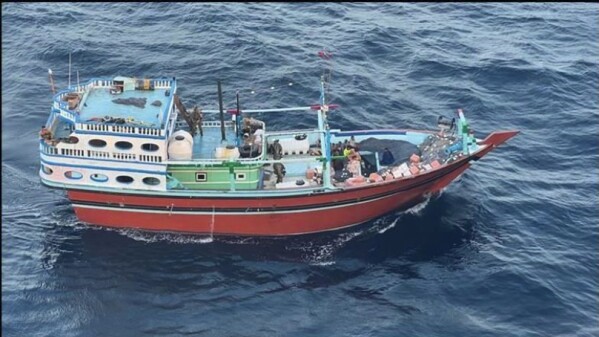
Within days, the responses began, with the first being a purely maritime operation. Intending to interdict shipments of Iranian weaponry to their Houthi proxies, members of Navy SEAL Team Three deployed from the USS LEWIS B PULLER ESB-3, an expeditionary mobile base positioned in the Arabian Sea under the cover of night in their small combatant boarding craft [24]. The January 11 raid targeted a flagless dhow transporting weapons and components to the Houthis via a smuggling route off the Somali coastline [24]. It was the first weapons interdiction raid of on a smuggling vessel during the current cycle of violence [25]. The SEALs boarded the dhow, overwhelming any defenses from the crew, and took control of the vessel and its nefarious cargo [24]. During the process of boarding, the rough seas pushed the SEALs’ vessel away from the dhow allowing for a man overboard incident in which Special Warfare Operator First Class Christopher Chambers, 37, slipped from the boarding ladder and plummeted into the dark ocean [24]. Trained to save his comrade, Special Warfare Operator Second Class Nathan Gage Ingram, 27, responded by throwing himself in the water [24]. Together the two disappeared into the abyss. The other SEALs were able to commandeer the dhow and confiscate an abundance of dangerous contraband [24]. This included components for ballistic and cruise missiles, related to propulsion, explosive warheads, and missile guidance, as well as pieces for Houthi air defenses [24]. The criminal dhow was declared unsafe for navigation and sunk by the SEALs, with the 14-member crew captured and detained by the American forces [25]. But with the immense loss of two of their own, the mission was incredibly costly. An eleven-day search was commenced, and although exhaustive, no sign of the fallen SEALs was discovered [24]. Thus, they were presumed and declared deceased, the first American casualties in the Red Sea conflict.
Unbeknownst to the Houthi, the next portion of the response would be a devastating display of military force and might. At 0200 on January 11, the restless Houthis continued as normal, launching the 27th attack on commercial shipping, although this time it was via an anti-ship ballistic missile fired into the shipping lanes within the Gulf of Aden [26]. The missile was in close enough proximity to the shipping vessels that its harmless impact into the water was directly observed by mariners [26]. The following day at approximately 0230, the Houthis finally faced bombardment [27].
USS FLORIDA SSGN 728 arose from the depths to launch Tomahawk Land Attack Missiles against militant targets [28]. Having first arrived in the Red Sea on November 23, FLORIDA was now displaying the capabilities of the submarine and its significant guided missile payload [28]. The components of the DWIGHT D EISENHOWER Strike Group moved into position with USS PHILIPPINE SEA CG-58, USS MASON, and USS GRAVELY also releasing Tomahawks towards Houthi positions [28]. A total of 22 fighter aircraft, including F/A-18s launched from the EISENHOWER for aerial attacks on Houthi facilities [28]. British forces directly participated as well [27]. This was in the form of four Typhoon fighter jets launched from the RAF Akrotiri base in Cyprus, plus two aerial refueling tankers supporting aircraft during the mission, all joining with American aircraft in flight [28]. In supporting roles for the retaliation, were the nations of Australia, Bahrain, Canada, and the Netherlands [27]. The US was adamant that the airstrikes were conducted separately from the previously formed and larger defensive coalition of Operation Prosperity Guardian [27]. The American announcement of the strikes made sure to hold the blame for the violence and necessity of the retaliation with the Houthis and Iranians, citing that their attacks on commercial shipping had impacted a great variety of nations, totaling 55 in all [27]. Tolerance for the Houthi actions was non-existent and thus warranted the response. This was despite President Biden’s wish to deescalate and prevent widening conflict in the region [28]. Thus, the strikes were described as self-defense and to end the threat to global commerce [28]. Across 16 separate locations, over 60 targets were devastated by 100 plus guided munitions in the early morning portion of the response [28]. Follow on strikes occurred later in the day across 12 additional locations [28]. At least 14 of the targets were damaged by British munitions at two locations, while the rest were targeted by the Americans [28]. Locations were chosen to prevent collateral damage and increase detriment to Houthi military infrastructure [28]. Houthi air defense positions and radar facilities and systems were slated for destruction [27]. This was in concert with strikes on the munition storage facilities and launch locations of the various one-way attack drones, cruise missiles, and ballistic missiles utilized by the Houthis in their campaign [27]. Command centers and weapons manufactories were reduced to rubble as well and impacts to the Hudaidah airport were reported [28].
Yahya Saree admitted to incurring casualties during the strikes, including five militants killed, but noted no overall concern, promising to resume attacks on international shipping [28]. Abdulmalik al-Houthi went further, promising retribution on the Americans beyond mere maritime attacks [28]. It remained to be seen if the American response was actually what the Iranians and Houthis desired, forcing the Americans into regional warfare [28]. A direct White House statement claimed the airstrikes citing the Houthi attacks as justification, and explaining how to date, over 2,000 freighter vessels had been diverted away from the Red Sea for thousands of miles resulting in detrimental financial consequences [29]. President Biden interestingly also described the January 9 barrage attack as a direct engagement against US naval forces, language that previously had been avoided by military officials [29]. By the end of the operation, forces had struck 28 different locations with over 150 precision munitions [30]. This included the previously mentioned Tomahawks from the submarine and surface vessels as well as guided bombs from the aircraft of the EISENHOWER [31]. In addition, the British Typhoons dropped their Paveway IV guided munitions [31]. American authorities expressed confidence that the airstrikes succeeded in the attrition of Houthi military capabilities [30]. The ongoing military operation received its formal name several days later on January 22, being denominated as Operation Poseidon Archer [32].
In keeping with the promise to continue attacks on shipping, the Houthis launched a ballistic missile towards the MT Khalissa in the Gulf of Aden, the following day on January 12, in what US officials described as a Houthi attempt to reestablish what their capabilities were after the airstrikes [17,28]. The missile did not impact the vessel but landed harmlessly in the ocean [17,28]. The master of the noticed three small craft following behind as well as the missile impact at a distance of 400 meters away [33]. Interestingly this incident was described as a mistake, due to the cargo of the Panamanian-flagged tanker consisting of Russian supplied oil, and the obvious Russian alliance with Iran [33]. USS CARNEY previously involved with multiple actions against Houthi projectiles, but not a participant in the initial strikes, received a chance to join the fray on January 13 [34]. At 0345 in the morning, the destroyer launched more Tomahawks against a surviving Houthi radar facility, again stressing the separation of this action from Operation Prosperity Guardian [34]. It seemed that the two sides were to continue taking shots at one another with the implementation of Poseidon Archer.
HOUTHI AND IRANIAN RESPONSES PLUS THE REDESIGNATION OF ANSARALLAH AS A FOREIGN TERRORIST ORGANIZATION
Meanwhile, the Iranians, in what was surely not a coincidence, raided and captured the Marshall Islands-flagged oil tanker St. Nikolas at 0630 January 11 in the Gulf of Oman [35]. Armed individuals in military fatigues and masks boarded the vessel and detained the crew of 19 [35]. The tanker was previously seized by American authorities for carrying sanctioned Iranian oil the year prior [35]. Now in retaliation, the Iranian navy captured the vessel and its cargo of Iraqi crude oil on its way to Turkey, veering it on a new course to Iranian ports [35]. A statement from White House authorities decried the action, demanding the release of the pirated vessel [35]. The Iranians were undoubtedly making a statement during the strikes on the Houthis.
While the strikes were extensive, across the 29 targets, the Houthi military complex was also significant. Also, launching capabilities were often mobile, providing the Americans with less structural, stationary targets, and ensuring that the militants could continue to take action against commercial shipping and US naval assets. As such, at 1645 on January 14 a Houthi anti-ship cruise missile launched towards the USS LABOON in the lower Red Sea [36]. Demonstrating cooperative capabilities, it was actually a US fighter jet that downed the projectile off the coast of Hudaidah, preventing any danger to LABOON or other nearby vessels [36].
Following this on January 15, the Houthis fired an anti-ship ballistic missile towards the commercial vessels in the Red Sea in a foundering attempt of disruption. This is because the missile achieved no success and its dysfunctional nature in flight resulted in it crashing to the ground in Yemen [37]. Hours later at 1600 though, the Houthis could claim success against a US owned merchant vessel. This anti-ship ballistic missile targeted and impacted the MV Gibraltar Eagle, owned and operated by Americans, and Marshall Islands-flagged [37]. The Gibraltar Eagle was 100 nautical miles from the coast of Yemen in the Gulf of Aden when the strike occurred [38]. Owned by Eagle Bulk Shipping in Stamford, Connecticut, this was the first American freighter that suffered a direct impact from the Houthis [38]. The port side cargo hold suffered minimal damage, and none of the crew sustained injuries, allowing the merchant ship to proceed onwards away from danger [38,39]. The carrier of steel products, the vessel turned away from its intended destination of the Suez Canal [39]. Yahya Saree celebrated the attack on television yet again, warning of more retribution against American and British shipping [39].
In certain retaliation for the Gibraltar Eagle strike, the Americans added to the success of Poseidon Archer by destroying four anti-ship ballistic missiles, poised for launch at their ground sites in Yemen [40]. The 0415 airstrike was declared by the Americans to be preventative, thus avoiding an immediate danger to Red Sea traffic [40]. The Houthis at 1345 that day were still able to launch another anti-ship ballistic missile towards the Red Sea shipping lanes, penetrating the Maltese-flagged MV Zografia [40]. The Greek owned Zografia was in fact traveling to Israel, culminating a long journey from Vietnam, when targeted and struck, but damage was again minimal and containable, and none of the 24 crew were injured [41]. Around 13 hours prior, Zografia was subject to an unusual approach by assumed Houthi small craft, eventually circling the vessel, but a warning shot from the crew seemed to be all the intervention necessary, and the craft departed [21]. This may well have been a Houthi method for spotting and selecting targets. After the approach and attack, Zografia then continued onward northward through the Red Sea [41,21]. Approaches were reported now with increased concern. MV Panda was reportedly followed by up to eight small craft around the same time as the Zografia incident, but no hostilities were engaged against the vessel [10,21]. Two days prior, the MV Orchid Rising was subjected to a suspicious approach and reported it [10,21]. However, it was assessed that the small craft actually belonged to the Eritrean Coast Guard [21]. Thus, not all of the incidents were legitimate Houthi or pirate threats. However, the Zografia proved that these the Houthis still employed these small craft. Perhaps since the Maersk Hangzhou incident, the Houthis had adjusted tactics to using these assets for harassment and spotting only. Regardless, Zografia again demonstrated the dangers of the mobile missile launch capabilities of the Houthis. Despite the removal of four ballistic missiles during the early morning, by afternoon another one was launched successfully.
Representing the futility of most warfare, a similar scenario played out on January 17. At 2030 a Houthi one-way attack drone impacted the Marshall Islands-flagged MV Genco Picardy while transiting in the Gulf of Aden [42]. For the second time, this was an attack against an American owned and operated vessel [42]. Genco Picardy remained steadfast, and continued onward, despite minimal damage [42]. No crew was injured in the incident [42]. By 2359 the same evening, the Americans responded by conducting airstrikes against launch rail systems with missiles loaded and ready [43]. In all fourteen of the projectiles and their launch systems were dismantled in the operation, the latest chapter of Poseidon Archer [43]. Yet again it was shown that despite the air superiority of those nations involved in Poseidon Archer, and the maritime superiority of those on the defensive in Prosperity Guardian; the Houthis were maintaining the agility and ability to strike almost daily. The Genco Picardy attack, resulting in a fire later contained by the crew, was in response to both the American military operation, and the political consequences again placed upon the Houthis [44]. Other nations continued to be drawn into the fray. From the Indian Navy, INS VISAKHAPATNAM responded to the distress call of the stricken vessel, eventually boarding to inspect the damages according to the Indian press, before escorting the Geno Picardy along its way [45].
As Poseidon Archer ramped up, the US State Department took the step of redesignating the Houthis as a terrorist organization, owning to the persistent attacks and threats against both commercial enterprises and naval assets [46]. The announcement came with the caveat of a 30-day delay, meaning that the full designation would not go into effect until February 16 [46]. The Americans were cognizant of the detrimental effects on Yemeni civilians and were striving to prevent them from taking the brunt of the measure [46]. The State Department implored the Houthis to cease their militant actions, but mainly desired to use the 30 days to ensure that proper aid and assistance could reach the Yemeni people from the appropriate entities [46]. Ansarallah was to be known as a terrorist network yet again.
In the next Chapter we will discuss the ongoing military maneuvers of Operation Poseidon Archer and its consequences, while examining the continued dangers to international shipping posed by the Houthis.
CITATIONS:
- [1] US says Houthi drones attacked warship, tankers in Red Sea, The Times of Israel, December 24, 2023, https://www.timesofisrael.com/liveblog_entry/us-says-houthi-drones-attacked-warship-tankers-in-red-sea/
- [2] USS Laboon shoots down four drones in Red Sea, by Diana Stancy, Navy Times, December 23, 2023, https://www.navytimes.com/news/your-navy/2023/12/24/uss-laboon-shoots-down-four-drones-in-red-sea/
- [3] Tanker hit off India coast by drone from Iran, says US, by Phelan Chatterjee, BBC News, December 24, 2023, https://www.bbc.com/news/world-asia-india-67811929
- [4] Drone attack sparked fire, total power failure on MV Chem Pluto, by Sidhant Sibal, World Is One News, December 29, 2023, https://web.archive.org/web/20231230061544/https:/www.wionews.com/india-news/drone-attack-sparked-fire-total-power-failure-on-mv-chem-pluto-674802
- [5] U.S. Forces Shoot Down Dozens of Houthi Missiles and Drones, Flash Brief – Foundation for Defense of Democracies, December 26, 2023, https://www.fdd.org/analysis/2023/12/26/u-s-forces-shoot-down-dozens-of-houthi-missiles-and-drones/
- [6] Massive One-Day Barrage of Houthi Attacks on Shipping Fended Off by Navy Destroyer, Fighter, by Konstantin Toropin, Military.com, December 26, 2023, https://www.military.com/daily-news/2023/12/26/navy-defends-against-17-houthi-attacks-red-sea-shipping-over-just-10-hour-period.html
- [7] US shoots down 12 Houthi attack drones, 5 missiles; Israeli jet downs Eilat-bound UAV, by Emanuel Fabian, Times of Israel, December 26, 2023, https://www.timesofisrael.com/witnesses-report-2-explosions-off-sinai-coast-strange-object-falling-into-water/
- [8] MSC Statement on MSC UNITED VIII Incident in Red Sea, MSC Press Release, December 26, 2023, https://www.msc.com/en/newsroom/press-releases/2023/msc-statement-on-msc-united-viii-incident-in-red-sea
- [9] Red Sea Attacks, by Simon Scarr, Adolfo Arranz, Jonathan Saul, Han Huang, and Jitesh Chowdhury, Reuters, February 2, 2024, https://www.reuters.com/graphics/ISRAEL-PALESTINIANS/SHIPPING-ARMS/lgvdnngeyvo/
- [10] Maritime Security Off Yemen Coast Threat Update, Operation Atalanta Threat Update, mschoa.org, January 27, 2024, 240127-atalanta-maritime-security-threat-update-red-sea_.pdf (mschoa.org)
- [11] USS Mason Shoots Down Houthi Anti-Ship Ballistic Missile, by Heather Mongilio, USNI News, December 28, 2023, https://news.usni.org/2023/12/28/uss-mason-shoots-down-houthi-anti-ship-ballistic-missile
- [12] Iranian-backed Houthi small boats attack merchant vessel and U.S. Navy helicopters in Southern Red Sea, US CENTCOM Press Statement, December 31, 2023, https://www.centcom.mil/MEDIA/STATEMENTS/Statements-View/Article/3644468/iranian-backed-houthi-small-boats-attack-merchant-vessel-and-us-navy-helicopter/
- [13] U.S. Helicopters Sink 3 Houthi Boats in Red Sea, Pentagon Says, by David E. Sanger, Eric Schmitt, and Vivek Shankar, The New York Times, December 31, 2023, https://www.nytimes.com/2023/12/31/world/middleeast/us-houthi-clash.html
- [14] US sinks Houthi boats in the Red Sea: How did the fight unfold?, Al-Jazeera, January 1, 2024, https://www.aljazeera.com/news/2024/1/1/us-sinks-houthi-boats-in-the-red-sea-how-did-the-fight-unfold
- [15] US Navy downs missiles in Red Sea after ship attacked by Houthi rebels, by Sam Jones, The Guardian, December 31, 2023, https://www.theguardian.com/world/2023/dec/31/missile-hits-red-sea-container-ship-us-destroyers-shoot-down-two-more
- [16] Houthis claim another Red Sea attack as shipping prices soar, The Times of Israel Staff and AFP, The Times of Israel, January 3, 2024, https://www.timesofisrael.com/houthis-claim-another-red-sea-attack-as-shipping-prices-soar/
- [17] AMBREY, Threat Circular for Indian Ocean Region, January 29, 2024, https://storymaps.arcgis.com/stories/421fb32ec0be48e088ce3da76e38ee9d?play=true&speed=slow
- [18] Houthi drone boat detonates in Red Sea a day after US warning, by Phil Stewart, Reuters, January 4, 2024, https://www.reuters.com/world/middle-east/houthi-drone-boat-detonates-red-sea-day-after-us-warning-2024-01-04/
- [19] USS Laboon Downs Houthi Attack Drone Over Red Sea, by Heather Mongilio, USNI News, January 6, 2024, https://news.usni.org/2024/01/06/uss-laboon-downs-houthi-attack-drone-over-red-sea
- [20] Houthi Leader: Ships Should Renounce Israel or Risk Attack, The Maritime Executive, January 7, 2024, https://maritime-executive.com/article/houthi-leader-asks-ships-to-renounce-israel-or-risk-attack
- [21] Skuld (Maritime Insurance Provider), Risk Intelligence – Security Threat Update: Red Sea, January 25, 2024, https://www.skuld.com/contentassets/6d41e7d51ed0497eb6e3184cd13e6703/recent-incidents—red-sea—25jan2024.pdf
- [22] US CENTCOM Statement on 26th Houthi attack on commercial shipping lanes in the Red Sea, USCENTCOM Press Statement, January 10, 2024, https://www.centcom.mil/MEDIA/STATEMENTS/Statements-View/Article/3639970/us-centcom-statement-on-26th-houthi-attack-on-commercial-shipping-lanes-in-the/
- [23] US Navy shoots down barrage of Houthi missiles and drones launched from Yemen over Red Sea, US Central Command says, by Oren Liebermann, CNN, January 10, 2024, https://www.cnn.com/2024/01/09/politics/us-navy-houthi-missiles-drones-red-sea/index.html
- [24] Death on the Arabian Sea: How a Navy SEAL fell into rough waters and another died trying to save him, by Lolita C Baldor, The Associated Press, January 31, 2024, https://apnews.com/article/seals-navy-deceased-weapons-raid-yemen-f0f9e334945a3ef5d85ed1fb165ad515
- [25] Two Missing Navy SEALs Helped Interdict Ship Transporting Weapons to Houthis, by Sam Lagrone, USNI News, January 16, 2024, https://news.usni.org/2024/01/16/two-missing-navy-seals-helped-interdict-ship-transporting-weapons-to-houthis
- [26] US CENTCOM Statement on 27th Houthi attack on commercial shipping lanes in the Gulf of Aden, USCENTCOM Press Statement, January 11, 2024, https://www.centcom.mil/MEDIA/STATEMENTS/Statements-View/Article/3643121/us-centcom-statement-on-27th-houthi-attack-on-commercial-shipping-lanes-in-the/
- [27] U.S. Forces, Allies Conduct Joint Strikes, USCENTCOM Press Release, January 11, 2024, https://www.centcom.mil/MEDIA/PRESS-RELEASES/Press-Release-View/Article/3643866/us-forces-allies-conduct-joint-strikes/
- [28] US and UK carry out strikes against Iran-backed Houthis in Yemen, by Oren Liebermann, Haley Britzky, Natasha Bertrand, Kevin Liptak, Alex Marquardt, MJ Lee, and Jennifer Hansler, CNN, January 12, 2024, https://www.cnn.com/2024/01/11/politics/us-strikes-houthis-yemen/index.html
- [29] Statement from President Joe Biden on Coalition Strikes in Houthi-Controlled Areas in Yemen, President Joe Biden, White House Statement, January 11, 2024, https://www.whitehouse.gov/briefing-room/statements-releases/2024/01/11/statement-from-president-joe-biden-on-coalition-strikes-in-houthi-controlled-areas-in-yemen/
- [30] Strikes Against Houthis Likely Effective in Degrading Rebel Group’s Capabilities, by Joseph Clarke, DOD News, January 12, 2024, https://www.defense.gov/News/News-Stories/Article/Article/3644831/strikes-against-houthis-likely-effective-in-degrading-rebel-groups-capabilities/
- [31] What kind of weapons are the US and UK using to strike Yemen’s Houthis?, by Brad Lendon, CNN, January 12, 2024, https://www.cnn.com/2024/01/12/middleeast/weapons-us-uk-using-to-strike-yemens-houthis-intl-hnk-ml/index.html
- [32] US names campaign to target Houthis in Yemen “Operation Poseidon Archer”, by Oren Liebermann and Natasha Bertrand, CNN, January 22, 2024, https://www.cnn.com/middleeast/live-news/israel-hamas-war-gaza-news-01-22-24/h_bcea34adfb7d01899d1d59278a3a9bfe
- [33] Houthis mistakenly target tanker carrying Russian oil, security firm says, by Adam Makary and Yomna Ehab, Reuters, January 12, 2024, https://www.reuters.com/world/middle-east/houthis-mistakenly-target-tanker-carrying-russian-oil-ambrey-report-2024-01-12/
- [34] U.S. Forces Strike Houthi Radar Site, USCENTCOM Press Release, January 13, 2024, https://www.centcom.mil/MEDIA/PRESS-RELEASES/Press-Release-View/Article/3644980/us-forces-strike-houthi-radar-site/
- [35] Iran seizes oil tanker involved in U.S.-Iran dispute in Gulf of Oman, by Jana Choukeir, Ahmed Elimam, and Robert Harvey, Reuters, January 15, 2024, https://www.reuters.com/business/autos-transportation/uk-shipping-authority-receives-report-vessel-boarded-by-armed-persons-off-oman-2024-01-11/
- [36] Houthis fire anti-ship cruise missile toward U.S. warship, USCENTCOM Press Release, January 14, 2024, https://www.centcom.mil/MEDIA/PRESS-RELEASES/Press-Release-View/Article/3645091/houthis-fire-anti-ship-cruise-missile-toward-us-warship/
- [37] Houthis strike commercial vessel in Southern Red Sea, USCENTCOM Press Release, January 15, 2024, https://www.centcom.mil/MEDIA/PRESS-RELEASES/Press-Release-View/Article/3645588/houthis-strike-commercial-vessel-in-southern-red-sea/
- [38] Eagle Bulk’s Gibraltar Eagle hit by Houthi missile, by Nick Blenkey, Marine Log, January 15, 2024, https://www.marinelog.com/news/eagle-bulks-gibraltar-eagle-hit-by-houthi-missile/
- [39] Houthi rebels strike cargo ship owned by Connecticut company, Connecticut Public Radio via The Associated Press, January 16, 2024, https://www.ctpublic.org/news/2024-01-16/houthi-rebels-strike-ship-owned-by-ct-based-company-in-the-gulf-of-aden-raising-tensions
- [40] U.S. Conducts Strikes in Yemen as Houthi Attacks Against International Shipping Continue, USCENTCOM Press Release, January 16, 2024, https://www.centcom.mil/MEDIA/PRESS-RELEASES/Press-Release-View/Article/3646109/us-conducts-strikes-in-yemen-as-houthi-attacks-against-international-shipping-c/
- [41] Red Sea attacks: Greek vessel hit by missile fired by Houthi rebels, by Kathryn Armstrong, BBC News, January 16, 2024, https://www.bbc.com/news/world-middle-east-67992600
- [42] Houthis attack U.S. owned and operated bulk carrier, USCENTCOM Press Release, January 17, 2024, https://www.centcom.mil/MEDIA/PRESS-RELEASES/Press-Release-View/Article/3648157/houthis-attack-us-owned-and-operated-bulk-carrier/
- [43] USCENTCOM Strikes Houthi Terrorist Missile Launchers, USCENTCOM Press Release, January 17, 2024, https://www.centcom.mil/MEDIA/PRESS-RELEASES/Press-Release-View/Article/3648253/uscentcom-strikes-houthi-terrorist-missile-launchers/
- [44] Houthis hit US cargo ship with drone after redesignation as global terrorists, by Patrick Wintour, The Guardian, January 17, 2024, https://www.theguardian.com/world/2024/jan/17/us-redesignates-houthis-as-global-terrorists-amid-red-sea-attacks
- [45] Indian warship responds to drone attack on merchant vessel in Gulf of Aden, by Rahul Singh, The Hindustan Times, January 18, 2024, https://www.hindustantimes.com/india-news/indian-warship-responds-to-drone-attack-on-merchant-vessel-in-gulf-of-aden-101705574877077.html
- [46] Terrorist Designation of the Houthis, Secretary Antony Blinken, US Department of State Press Release, January 17, 2024, https://www.state.gov/terrorist-designation-of-the-houthis/
© Copyright 2024 Nolan R Beasley
 Chronicles in Zealotry